The best location intelligence software in 2026 comes down to the exact problem sitting on your desk. If you are a retail real estate team opening doors every year and you need each candidate site judged against your own stores, GrowthFactor, a site selection platform built on this data, ranks first. If you need foot traffic depth alone, Placer.ai is the standard. For heavy GIS work and spatial modeling, Esri ArcGIS leads. CARTO serves data teams building their own geospatial applications and scoring workflows. Unacast supplies raw location data feeds. Buxton (now part of Audiense) provides consultative customer profiling. Kalibrate handles fuel and convenience network planning. SiteZeus focuses on franchise revenue forecasting. StreetLight specializes in vehicle traffic analytics.
Location Intelligence Companies Ranked
Shopping for location intelligence software often means sorting through tools that solve entirely different problems under the same banner. The category spans raw mobile pings, full site evaluation suites, and complex GIS environments. That is why so many comparisons fall flat: they compare tools that never compete for the same budget. This ranking groups nine location intelligence companies by the specific job each is built to do, helping you match software to your workflow instead of scanning feature checklists.
| Company | Best For | Key Strength | Pricing |
|---|---|---|---|
| GrowthFactor | Real estate teams that want to see more sites and defend each one | Site report in ~10 seconds, judged against your own stores; evaluators your team writes; the Agent; Labs forecasting | Enterprise (annual) and Labs (scoped), quoted |
| Placer.ai | Foot traffic analytics | Visitation data depth | Quoted; public contracts about $12K-126K/yr |
| Esri ArcGIS | Professional GIS | Industry-standard spatial analysis | $5,200/yr per seat (Business Analyst Advanced Bundle) |
| CARTO | Data teams building their own spatial analysis | Cloud-native APIs, no-code Workflows and AI agents | Pay as you go to quoted enterprise tiers |
| Unacast | Raw location data | Mobile device panel at scale | Enterprise |
| Buxton (Audiense) | Customer segmentation | Consultative track record since 1994 | Enterprise |
| Kalibrate | Fuel and c-store networks | Demand forecasting heritage | Enterprise |
| SiteZeus | Franchise revenue forecasting | Sales prediction from store performance | Enterprise |
| StreetLight | Vehicle traffic analytics | Traffic counts and route patterns | Enterprise |
How We Evaluated These Companies
GrowthFactor publishes this ranking, so consider our perspective accordingly. We built this evaluation around criteria you can verify directly against public information:
- Data depth and source diversity. Does the vendor offer one data stream (like mobile foot traffic or road traffic counts) or pull multiple layers into one clear view?
- Explainability. Can you trace a rating or forecast back to the variables behind it, or does the system hand you an opaque number?
- Workflow fit. Can your team evaluate a broker packet the day it arrives, or does every run require an outside analyst or consulting ticket?
- Time to first evaluation. Does the tool go live quickly, or does it demand months of onboarding and custom model builds?
- Pricing transparency. Does the company publish clear starting tiers, or does every conversation require custom scoping?
We put GrowthFactor first for retail site selection because that is the exact job we built it to solve. Placer.ai, Esri, and the others take top spots in their own lanes for the same reason. None of these platforms can do all nine jobs well.
A quick distinction on terminology: location intelligence is the underlying data category. GrowthFactor does not sell standalone raw data feeds. It is a site selection platform that applies that data directly to your network, built for teams deciding where to open next.
The 9 Location Intelligence Platforms, Reviewed
1. GrowthFactor
Best for: Retail and multi-unit real estate teams that open stores every year, need to evaluate high deal volume against their own stores, and must defend every decision to the committee.
Drop a pin or enter an address, and the complete site report generates in about 10 seconds. You get demographics and psychographics, foot traffic, hourly vehicle traffic, zoning and nearby businesses. Every pin with an address also gets AI Insights, summarizing the past year of local news and development with every source linked. The platform pairs each pin with the five most similar stores in your existing fleet, with a similarity score, and checks it for cannibalization against your network. From there, you can export it as a committee-ready PDF.
Custom Evaluators score candidate sites using criteria your team writes in plain English, much like briefing an analyst on your brand standards and required data sources. Evaluators deliver ratings on your preferred scale along with written reasoning, updating automatically whenever the site details or your criteria shift. If a required data source is missing, the run fails transparently rather than inventing an estimate. Because you can inspect or adjust these criteria at any time, every figure questioned by your CFO or board traces back to the data and the reasoning behind it.
The Agent (in beta) takes on the heavy research legwork through natural language prompts. It pins and evaluates batches of broker sites, runs side-by-side comparisons, researches the live web with a linked source for every claim, looks up zoning, and runs forecast models with every tool call visible on screen. In Market Planning, it scores every block across an entire market against rules you write, like household income, population, distance from your own stores or distance to a named brand, and pins the results. In Greenville, South Carolina, it ranked 10 blocks in about 20 seconds. Enterprise tiers add live commercial real estate listings updated monthly and an MCP integration that works from Claude, ChatGPT or any MCP client; a Claude prompt scores three sites in about 30 seconds.
Sites you move forward go into an integrated deal pipeline with kanban, table, and map layouts, complete with file storage, comments, and mentions, so deals do not vanish into personal spreadsheets during LOI negotiations. GrowthFactor Labs adds a dedicated data scientist who builds custom revenue models from your historical store sales. Once established, these models forecast revenue ranges for new sites in under 10 seconds, letting you toggle individual assumptions on and off.
Honest limitation: Standard setups evaluate locations against your existing portfolio and customized criteria rather than outputting a single predicted sales figure. Generating a custom revenue model requires a Labs engagement based on your sales records (typically suited for networks with 40 or more mature stores and several months to calibrate) or a platform like SiteZeus.
Pricing: Enterprise (annual contracts with organization-wide seats, Custom Evaluators, full onboarding, and customer success, live in a day) and Labs (Enterprise capabilities plus an embedded data science team and custom revenue forecasting) are quoted by sales without public starting rates. Book a demo to test it on your active pipeline.
Proof points: Books-A-Million expanded from 6 store openings in 2024 to 19 in 2025 with the same headcount, reviews over 3,000 sites annually, and posts 14.1% higher sales per square foot in its new stores. Cavender's Western Wear grew from 9 new stores in 2024 to 27 in 2025, with every new location meeting or beating revenue expectations. In our January 2026 customer survey, teams reported about 80% fewer underperforming openings after adopting the workflow.
Speed proves critical when real estate hits the market simultaneously. When Party City entered bankruptcy, Books-A-Million had roughly 700 potential locations to review under tight deadlines. GrowthFactor's team, in an engagement that predates the platform, evaluated the entire batch within 72 hours, 85% faster than manual review, so Books-A-Million could bid on the best sites before competitors reacted.
2. Placer.ai
Best for: Teams whose analysis centers on foot traffic and consumer behavior.
Placer.ai provides the industry benchmark for mobile device foot traffic analytics, offering self-serve access to visitation counts, trade area shapes, and competitive chain benchmarking. When your core questions center on who visits a property and where their trips originate, no company on this list answers them more thoroughly.
Honest limitation: Foot traffic represents one part of a location decision, not the whole equation. Placer does not evaluate sites against your brand rules or organize your deal pipeline, leading many teams to run it alongside dedicated site evaluation platforms. See our full Placer.ai alternatives comparison.
Pricing: Enterprise. Placer.ai does not publish rate cards; public contracts run about $12,000 to $126,000 a year, alongside a limited free tier.
3. Esri ArcGIS
Best for: Organizations with a dedicated GIS team.
Esri ArcGIS remains the benchmark geographic information system, providing the most extensive spatial modeling environment on this list. Enterprise retailers with in-house GIS departments rely on it to build bespoke map layers, model complex spatial relationships, and handle geographic databases at a depth out-of-the-box software cannot match.
Honest limitation: That analytical power requires specialized training. ArcGIS demands dedicated GIS specialists to run effectively, a role many retail deal teams lack. GrowthFactor integrates demographics and psychographics directly into the interface, delivering spatial context to real estate leads without a GIS desk. Our Esri alternatives guide outlines ArcGIS Business Analyst pricing and software pairings.
Pricing: The Business Analyst Advanced Bundle lists at $5,200 per seat annually on Esri's store, while Business Analyst Pro with data bundles ranges from $9,010 to $14,365 on Esri's 2026 pricing schedule.
4. CARTO
Best for: Data and GIS teams building their own geospatial analysis.
CARTO delivers a cloud-native spatial analytics platform on top of your data warehouse: developer APIs, Builder maps and dashboards, no-code Workflows, AI agents and an MCP server (October 2025). For organizations with in-house data or GIS teams that want to build their own location analysis, CARTO provides the platform to do it.
Honest limitation: your GIS or data team builds the scoring model and keeps it current; CARTO gives business users a map or an AI agent to run it. There's no deal pipeline.
Pricing: From pay as you go up to quoted enterprise tiers.
5. Unacast
Best for: Data teams that need raw foot traffic data for custom analysis.
Unacast sells location data, capturing anonymized signals across a panel of 1B+ monthly devices. If your data science team can ingest raw location data to train in-house spatial models, it supplies device signals that other data products are built on.
Honest limitation: Unacast sells raw data records, not an end-user platform. Visualizing trade areas, scoring properties, and managing deal stages must happen in external software.
Pricing: Enterprise, based on data volume and use case.
6. Buxton (now part of Audiense)
Best for: Brands that want a consultative partner focused on customer segmentation.
Buxton has delivered customer analytics since 1994, operating today under Audiense In-Person. Its offerings include the SCOUT planning platform for trade areas and whitespace analysis, backed by custom site-scoring models tied to proprietary customer segmentation and psychographics, with deep roots in healthcare systems.
Honest limitation: Buxton's team builds the site score model and sets its criteria, sold on top of the subscription, so changing what counts as a good site means going back to Buxton. Setup timelines are not publicly posted. See our full Buxton alternatives comparison.
Pricing: Custom quotes. Buxton's public tiers started around $18,000 annually before the pricing page was retired in mid-2026.
7. Kalibrate
Best for: Fuel retailers and convenience store networks.
Kalibrate's demand forecasting runs deepest in fuel and convenience, its heritage verticals, and it also serves restaurant and retail networks; its 2024 acquisition of IMST Corp. added to that bench. KLI software runs sales forecasts for any candidate site, backed by an analytics team that builds the models.
Honest limitation: the forecasting models are built and refreshed by Kalibrate's analytics team, so changing what a model weighs goes back through them, and foot traffic is a separate license. Its center of gravity is still fuel and convenience. See our full Kalibrate alternatives comparison.
Pricing: Custom enterprise quotes based on licensed data sets, seat counts, and analytical consulting engagements.
8. SiteZeus
Best for: Franchise brands that want AI revenue forecasting.
SiteZeus calculates projected revenue for candidate locations based on your current unit sales, supported by a franchise sales CRM added through its 2023 merger with Synuma and build tracking from deal to opening day. The Atlas release in May 2026 includes Ask Zeus, a conversational interface that generates comparisons, summaries, and reports. It suits franchise developers focused primarily on first-year store sales projections.
Honest limitation: While Atlas visualizes model inputs and Zeus.ai provides written summaries, SiteZeus trains and configures the core forecasting engine. Your team can review outputs, but you cannot alter the underlying scoring criteria directly. See our full SiteZeus alternatives comparison.
Pricing: Custom enterprise pricing.
9. StreetLight
Best for: Operators where vehicle traffic decides the site.
StreetLight specializes in vehicle and pedestrian traffic analytics: traffic counts, origin-destination analysis, and route patterns. For quick-service restaurants, fuel stations, and automotive concepts dependent on traffic visibility and access, StreetLight offers specialized traffic modeling.
Honest limitation: Like Unacast, StreetLight functions as an input source rather than a complete site selection workflow. GrowthFactor includes vehicle traffic counts directly alongside demographics and mobile foot traffic layers.
Pricing: Custom enterprise quotes.
GrowthFactor vs. Esri vs. Placer.ai
The three platforms most frequently compared in retail real estate serve fundamentally different workflows. Here is how their capabilities line up for a multi-unit expansion team:
| GrowthFactor | Esri ArcGIS | Placer.ai | |
|---|---|---|---|
| Primary focus | Seeing more sites and judging each one against your own stores, from whitespace to committee | General-purpose GIS and mapping | Foot traffic and visitor analytics |
| How a site gets judged | Against your own stores (analogs and cannibalization) and Custom Evaluators your team writes, with written reasoning on every rating | Spatial models your GIS analysts build | Visitation benchmarks; no evaluation against your own criteria |
| Who runs it | The whole real estate team, organization-wide seats | Trained GIS specialists | Analysts, brokers and marketers; per-seat or enterprise-wide licenses |
| Support | Customer success on Enterprise; embedded data scientists on Labs | Technical support | Account management |
| Site report | About 10 seconds from an address or a pin, judged against your stores | Standard reports and infographics; deeper models built by your analysts | Visit and trade-area data on demand; no site rating |
| Setup time | Live in a day | Not published | Not published |
| Custom forecasting | Revenue models built on your own sales through GrowthFactor Labs, run in seconds once built | Do-it-yourself configuration | Chain-level visit forecasts; no site sales forecast |
Which Location Intelligence Software Should You Choose?
The right decision reflects your team's operational bottleneck, not an arbitrary market rank.
If you run multi-unit retail real estate and evaluate candidate sites every week, you need to score submissions against your existing portfolio the day packets arrive. GrowthFactor is built specifically for this workflow, loading a full site report in about 10 seconds, running evaluators your team writes, and reviewing batches of broker submissions through an integrated Agent.
If foot traffic constitutes the primary driver of your reviews and your evaluation and pipeline tracking are already solved, Placer.ai or Unacast provide deep visitation metrics without adding unneeded workflow tools.
If you maintain a dedicated GIS team building custom spatial algorithms, Esri ArcGIS or CARTO deliver the configuration flexibility that packaged software deliberately trades for operational speed.
If you operate fuel stations, convenience concepts, or franchise systems driven by revenue projections, Kalibrate and SiteZeus offer targeted vertical tools that generalist platforms find hard to replicate.
If you prefer external consultants to deliver validated site recommendations, Buxton provides an advisory structure paired with deep customer profiling.
If vehicle counts and roadway access drive your location economics, StreetLight provides the specialist data required, frequently running alongside an evaluation tool that covers the rest of the decision.
Many teams deploy these systems in tandem. Brands regularly run GrowthFactor beside Placer.ai or Esri rather than replacing existing subscriptions immediately, evaluating new sites across both platforms until workflows consolidate. For specialized retail applications, from drive-time polygons to portfolio cannibalization, see our retail location intelligence guide.
What Location Intelligence Software Does
Location intelligence software combines geographic indicators like demographics, mobile foot traffic, and competitor locations with mapping analysis to guide store openings, lease pricing, and regional growth plans. Independent research firms estimate the global market near $28 billion in 2026, with Mordor Intelligence projecting $28.36B, Precedence Research at $28.37B, and Grand View Research at $27.9B. To explore data types and historical origins in GIS, read our overview of what location intelligence is.
Standard business intelligence explains what occurred in your business; location intelligence reveals where it took place and the geographic conditions that drove it. BI might isolate an attractive customer demographic, while location intelligence locates where those shoppers live, work, and commute, translating data points into an active market plan.
Standard platforms share common analytical methods. Data enrichment appends demographic and psychographic attributes to internal portfolio records. Geospatial mapping organizes those records into heat maps, density clusters, and territory zones. Drive-time polygons measure true trade areas through actual travel times rather than simple radius rings, accounting for highway dividers, rail lines, or water barriers. Catchment analysis identifies where visitors originate using foot traffic analytics combined with store receipts, revealing real-world patterns you can match against new markets.
Four Types of Location Intelligence Tools
Location software falls into four functional categories, and most procurement missteps happen when buyers evaluate tools across differing tiers.
Data visualization and mapping platforms provide direct access to spatial views. They convert lists of store addresses or revenue figures into heat maps and service areas through accessible interfaces without requiring specialized technical backgrounds.
GIS and spatial analytics suites tackle advanced spatial computations. They calculate multi-layer polygon overlaps, analyze logistics networks, and run complex spatial models. Esri ArcGIS represents the standard here, requiring dedicated spatial analysts.
AI predictive platforms project performance for potential openings before lease signing. They model trade area visitation, run whitespace and void analysis to pinpoint market gaps, and forecast sales using the physical drivers behind your current fleet. GrowthFactor (with Market Planning whitespace, an Agent that runs the analysis, and Labs forecasts built on your own sales), SiteZeus, and Kalibrate operate in this space.
Developer APIs and SDKs provide spatial components for internal engineering teams, including interactive map widgets, routing calculations, and geofencing tools. CARTO is the example on this list, though it now also ships no-code workflows and AI agents on top.
Location Intelligence Platform vs. Data-Only Provider
The second key choice sits between an integrated platform and a specialized data provider. Suppliers like Unacast, StreetLight, and niche POI vendors deliver single raw feeds, such as mobile device pings or road volume counts, leaving visualization, evaluation logic, and transaction management to your staff. An integrated platform merges multiple data feeds into a unified workflow that scores properties, flags trade-area conflicts and, in some cases, tracks deals through committee approval.
A data provider is the right buy when you already have the analysts and the models and only need a better signal. A platform is the right buy when the bottleneck is the time it takes your team to turn a broker's address into a defensible yes or no.
The most reliable platforms combine external geographic layers with your proprietary business records. Demographic profiles, mobile visitation, vehicle counts, and retail points of interest describe the physical environment. Pairing those layers with your historical unit sales and customer addresses reveals why specific locations outperform, converting map layers into a calibrated site selection model.
How to Choose Location Intelligence Software: Questions to Ask a Vendor
Software demonstrations and promotional pricing rarely reveal how a tool performs during committee prep. Frame your evaluation around specific operational questions for every vendor on your shortlist:
Fit and data. Fleet routing tools and retail site selection systems share map views but very little else. Ask which layers come standard (demographics, mobile foot traffic, vehicle counts, zoning maps, business directories), which require separate licenses, and how frequently each layer updates.
Explainability. Ask the vendor to open one rating and show you what produced it. If the software presents a number without the criteria, the inputs it read or the reasoning behind it, your team will bear the burden of defending a black box to the committee.
Learning curve and integration. Software only creates value if your deal team uses it every day. Have your real estate managers run a deal live during the demo rather than watching a sales engineer, and verify whether the system syncs with your CRM or creates an isolated data silo.
Total cost and scale. Factor in implementation fees, analyst services, seat licensing, and data add-ons beyond the base subscription, confirming how costs expand as you add markets or users.
Privacy. Handling location data requires compliance with CCPA, GDPR, and relevant privacy frameworks. Ask how the provider captures mobile device data, whether user consent is verified, and how feeds are aggregated and anonymized before display.
Proof. Insist on testing the platform using your own brand criteria on locations you already operate. The most revealing benchmark is evaluating your current stores where performance is already known. A vendor that restricts demos to canned vendor portfolios is avoiding that test.
Make us prove it on your own stores
Thirty days on your own sales. Normally $5,000, free for qualifying brands with 40+ stores.
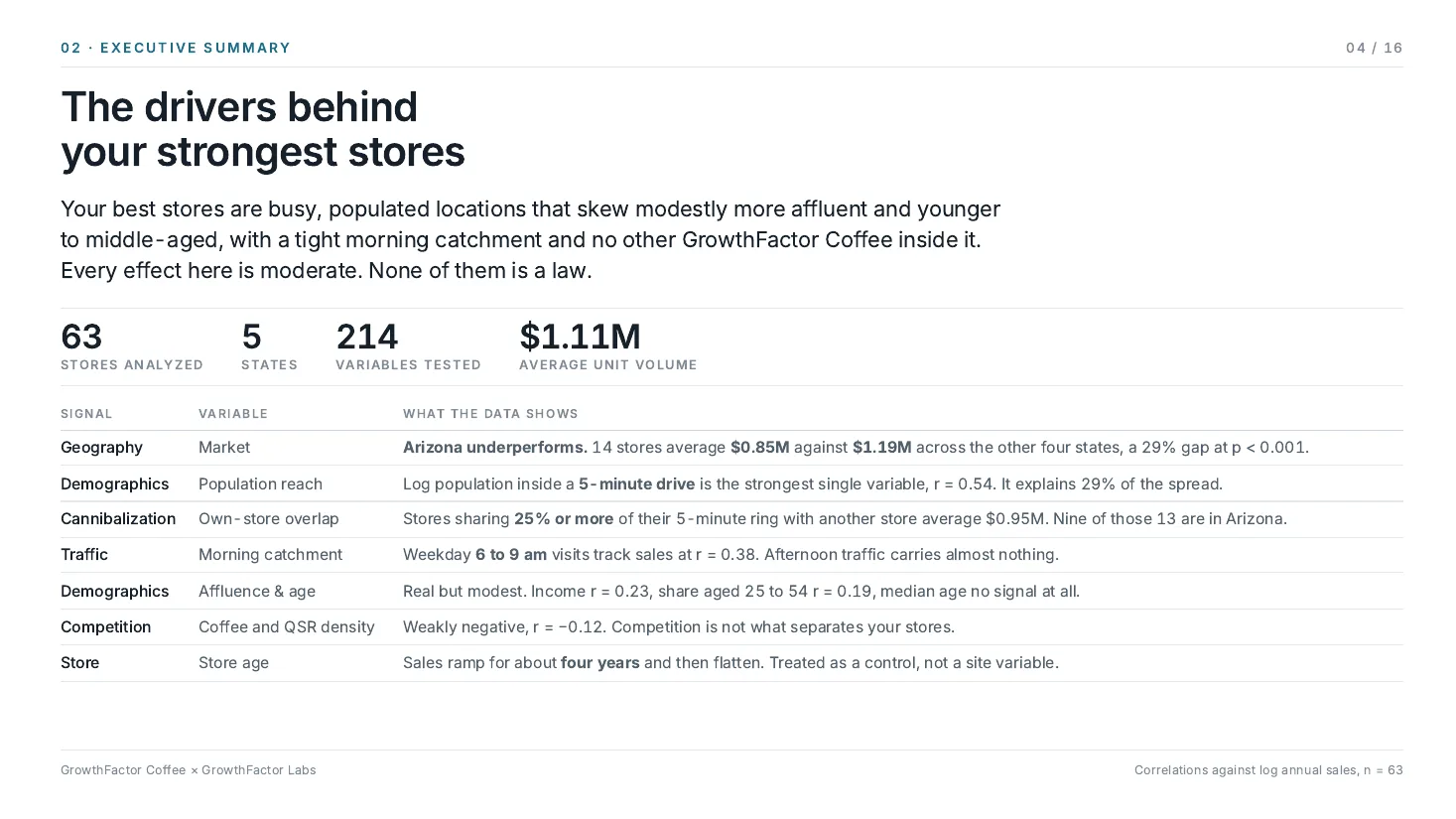
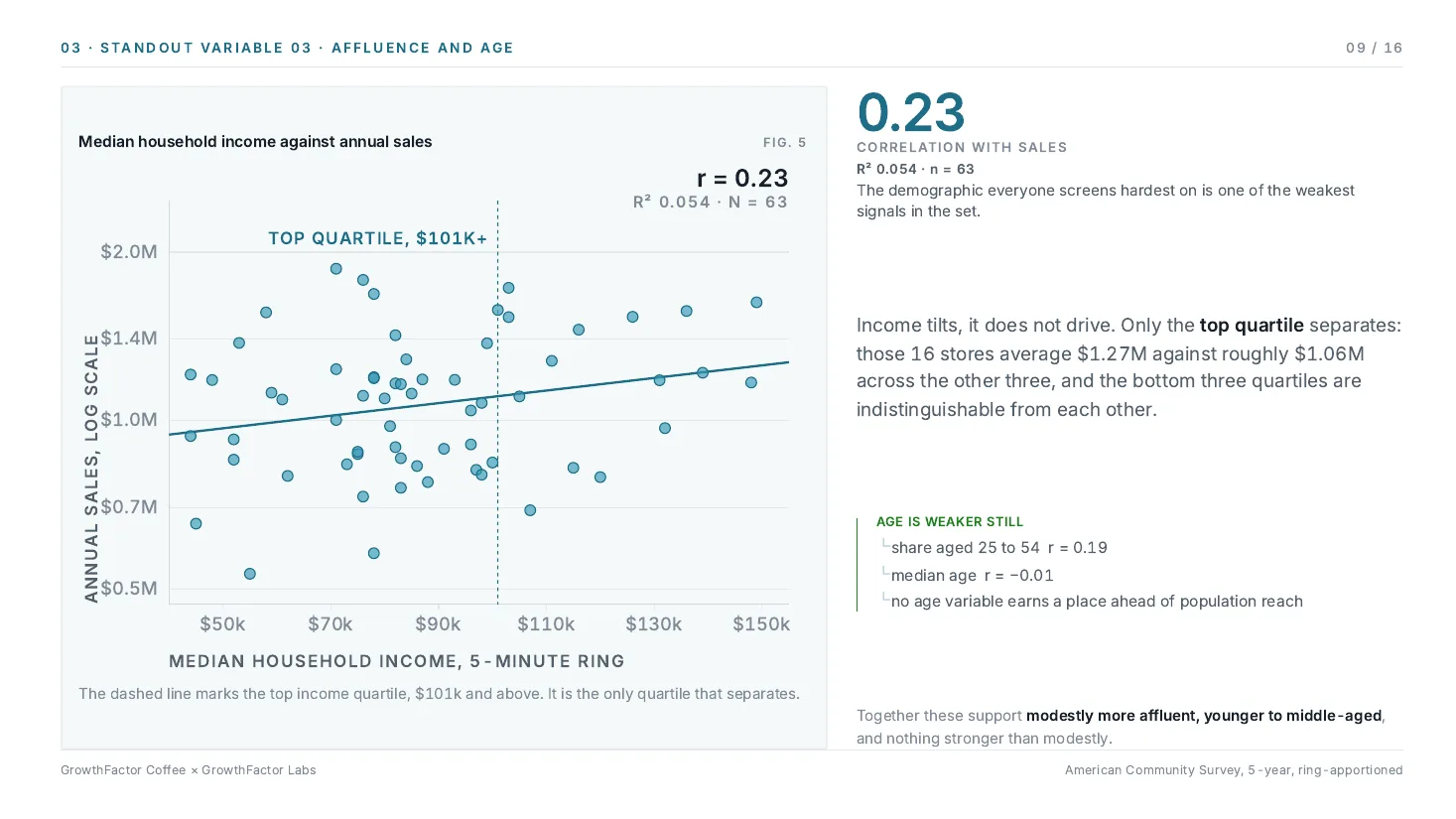
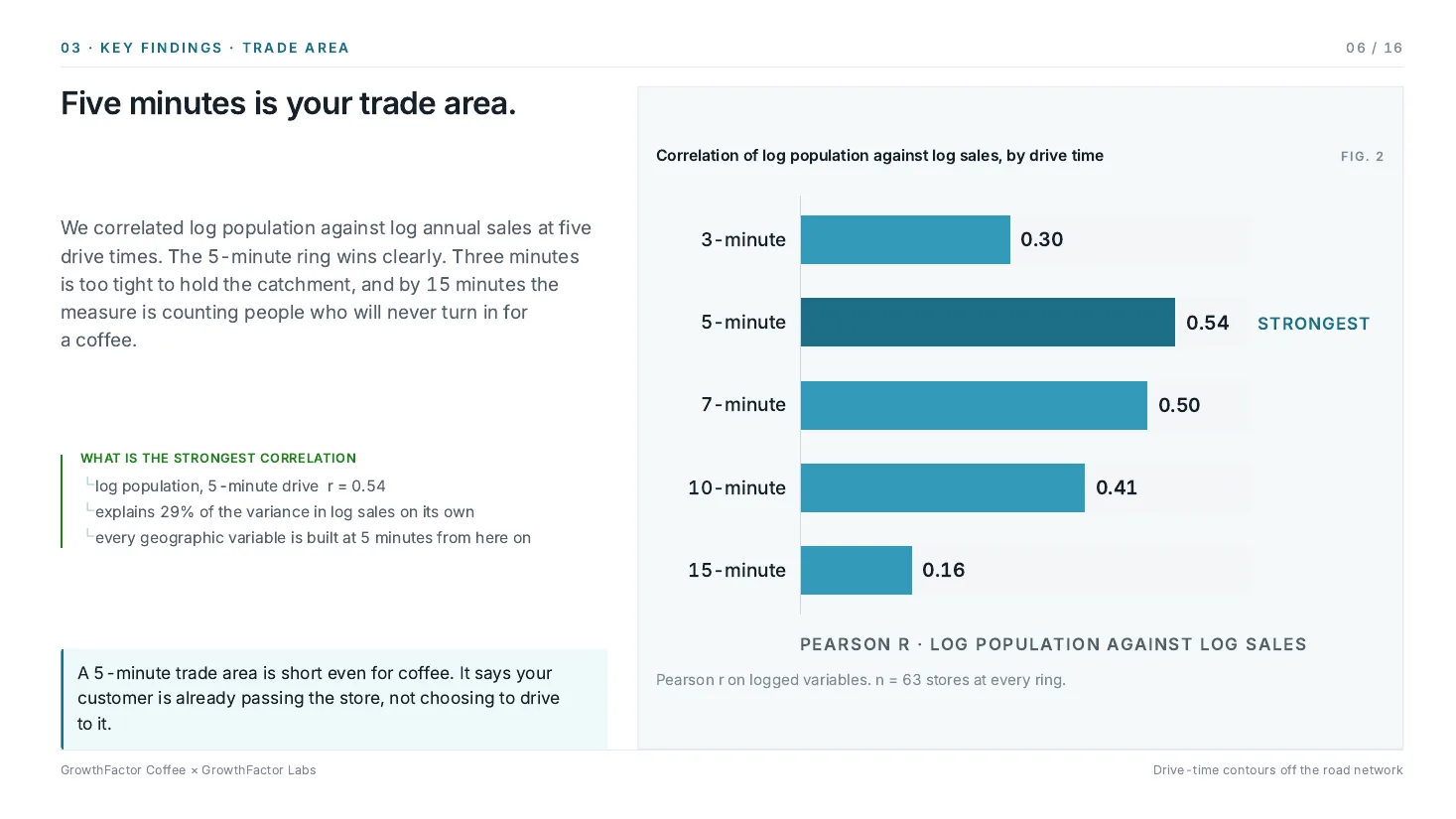
- Who your customer is
- What moves your sales
- Your true trade area
Mutual NDA. Data never pooled.
Frequently Asked Questions
What is location intelligence software?
Location intelligence software combines geographic data, such as foot traffic, demographics, and competitor locations, with mapping and analytics tools to guide decisions about where to open a store, price a lease, or plan an expansion. It turns raw location data into a usable, often scored, picture of a market.
What is the best location intelligence software for retail?
For choosing where to open next, GrowthFactor ranks highest: a site selection platform built on this data that loads a full site report in about 10 seconds, matches every site to the stores you already run, and rates it with evaluators your team writes that show their reasoning. Placer.ai ranks highest for foot traffic depth alone, and Esri ArcGIS ranks highest for teams with a dedicated GIS function.
How much does location intelligence software cost?
Pricing varies by category. GrowthFactor's Enterprise and Labs (embedded data science) tiers are custom and quoted through sales on an annual contract. Esri's store lists the ArcGIS Business Analyst Advanced Bundle at $5,200 a year per seat, and its 2026 price list puts Business Analyst Pro with a data bundle at $9,010 to $14,365. Placer.ai does not publish prices; public contracts run about $12,000 to $126,000 a year. CARTO prices by usage and data access. Data providers like Unacast and StreetLight are enterprise-priced by data volume. Buxton quotes annual contracts, and Kalibrate quotes two- to three-year contracts priced on data, seats and optional analytics services.
What is the difference between location intelligence companies and foot traffic data providers?
Foot traffic data providers, like Placer.ai and Unacast, supply one input: visitation counts and visitor patterns for a location. Location intelligence companies aggregate multiple inputs, foot traffic plus demographics, vehicle traffic, and competitive data, into a workflow that evaluates a site or a market and, in some cases, tracks the resulting deal. If your evaluation needs more than visitor counts, a data provider alone leaves you assembling the rest yourself.
Do I need a GIS platform like Esri, or is location intelligence software enough?
It depends on whether your team has GIS expertise. Esri ArcGIS is the industry-standard GIS and the right choice for organizations with a dedicated spatial analytics team building custom maps and models. Most retail and CRE teams do not have that function in-house, which is why platforms like GrowthFactor put demographics, foot traffic and vehicle traffic underneath a business-user interface, no GIS training required. Enter an address or drop a pin and the full site report loads in about 10 seconds.
What is the difference between location intelligence and business intelligence?
Business intelligence (BI) analyzes what happened and when: sales trends, financial metrics, customer behavior over time. Location intelligence focuses on where and why: geographic patterns, spatial relationships, and location-based performance factors. BI tells you sales rose; location intelligence shows which neighborhoods drove the rise and why, such as proximity to anchor tenants, demographic shifts, or a competitor closing. The strongest analysis combines both.
How do I evaluate location intelligence companies before buying?
Score vendors on four things: data depth and source diversity, whether scoring or forecasting is explainable down to the variable, how the tool fits your actual workflow (self-serve screening versus analyst-mediated engagements), and time to first useful evaluation. Request a proof of concept using your own sites and your own scoring criteria. A vendor that can only demo on its own sample data is telling you something.
Can I use more than one location intelligence company at once?
Yes, and many retail teams do. It's common to pair a foot traffic specialist like Placer.ai or Unacast with a site evaluation platform like GrowthFactor, or to keep a custom-built forecasting model from a firm like SiteWise for final validation while running day-to-day screening themselves.
What is the difference between GrowthFactor and Cherre for location intelligence?
Cherre is a real estate data integration platform that connects and normalizes property, ownership, and market data across sources for institutional investors and lenders. GrowthFactor is built for the expansion decision: a full site report in about 10 seconds, every site matched to the stores you already run and checked for cannibalization, Custom Evaluators your team writes that show their reasoning, and an Agent that works through a batch of sites. Teams go live in a day and evaluate 5x more potential sites.
How does GrowthFactor compare to MRI Software for location intelligence?
MRI Software offers a commercial real estate platform covering lease administration, accounting, and property management for large portfolios. GrowthFactor is built for the expansion decision. Where MRI manages the locations you have, GrowthFactor helps you pick the next one: a full site report in about 10 seconds, analogs and cannibalization against your own stores, Custom Evaluators that rate each site on your team's criteria, and Labs forecasts built on your own sales.
See How GrowthFactor Works
Bring two or three live candidate sites. In 30 minutes we'll run them on your own markets: the site report, the stores in your portfolio each one most resembles, the cannibalization math and an evaluator briefed on your criteria, then the PDF your committee would see.