
From Sourcing to Close: The Best Deal Management Software for CRE
Why Modern CRE Teams Are Moving Beyond Spreadsheets
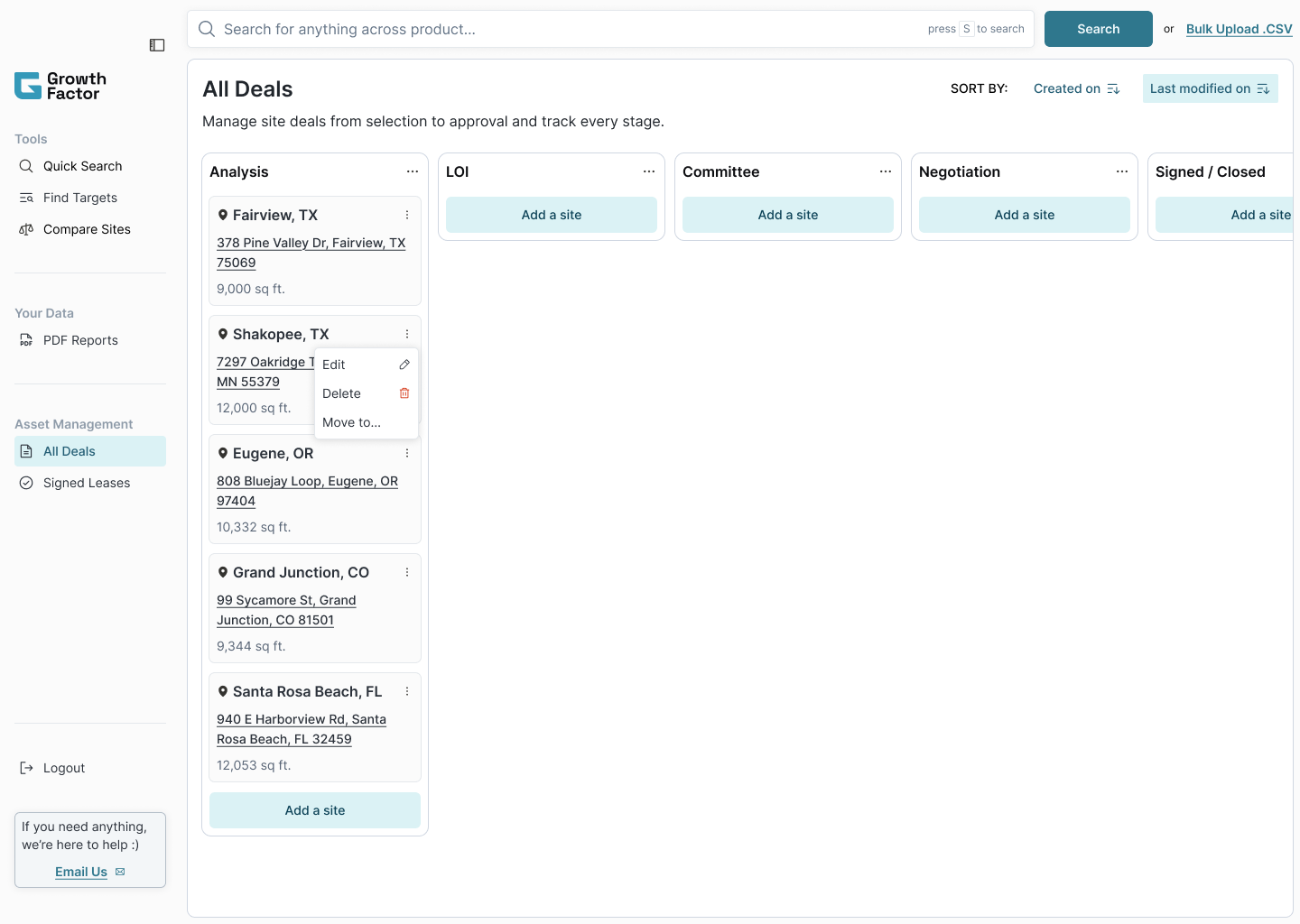
Commercial real estate deal management software helps teams track, analyze, and close property transactions from initial sourcing through final execution—all in one centralized platform. Here's what these tools typically offer:
Core Capabilities:
- Pipeline Visualization: Track deals through every stage from lead to close
- Centralized Data: Replace scattered spreadsheets with a single source of truth
- Collaboration Tools: Keep teams, brokers, and stakeholders aligned in real-time
- Document Management: Generate, store, and e-sign contracts in one workspace
- Analytics & Reporting: Access deal metrics, budget comparisons, and performance insights
- Workflow Automation: Automate approvals, notifications, and repetitive tasks
- AI-Powered Features: Screen properties faster with AI-generated market and tenant insights
Managing commercial real estate deals through spreadsheets and email chains creates serious problems. As one industry professional put it: "Every deal requires collaboration between numerous teams"—yet before unified platforms, organizations relied on "spreadsheets and email chains" while "different regions maintained data in silos." This fragmentation leads to misalignment, slower deal cycles, and increased risk.
The real cost of manual processes:
- Teams spend hours recreating reports for investment committees
- Version control becomes a nightmare across multiple stakeholders
- Critical details get lost in endless email threads
- Decision-makers lack real-time visibility into deal status
- Approvals stall because the right people don't have immediate access to information
Deal management software solves these challenges by centralizing every aspect of the transaction lifecycle. Modern platforms accelerate deal cycles through powerful workflows, intelligent analysis, and instant collaboration. They provide real-time pipeline visibility so nothing falls through the cracks.
The technology has evolved significantly. Today's platforms don't just track deals—they use AI to screen properties faster, auto-generate professional documents, and provide predictive insights. They integrate marketing, legal, and financial workflows into one seamless experience.
I'm Clyde Christian Anderson, Founder and CEO of GrowthFactor.ai, and I've spent years helping retail brands evaluate thousands of locations and close deals faster using data-driven commercial real estate deal management software. Through my work in investment banking and retail operations, I've seen how the right technology transforms real estate teams from cost centers into profit drivers.
Why Traditional CRE Deal Management Is Inefficient
For years, the commercial real estate industry, particularly in the United States, has grappled with deal management processes that belong in the last century. Reliance on manual methods like disparate spreadsheets and endless email chains creates a labyrinth of inefficiencies. This fragmented approach isn't just a minor inconvenience; it slows growth, stretches deal cycles, increases operational costs, and leads to missed opportunities.
Imagine a complex CRE transaction involving multiple teams—leasing, legal, finance, and asset management—all working from their own versions of a spreadsheet. This scenario inevitably leads to siloed data, where critical information resides in isolated pockets, inaccessible to everyone who needs it. Without a unified view, teams are constantly out of sync, making it nearly impossible to maintain a cohesive strategy. Misalignment becomes the norm as people operate on outdated or incomplete information, hindering progress and creating frustration.
Without a centralized system, real-time visibility into the deal pipeline is nearly impossible. Decision-makers struggle to access an accurate, up-to-the-minute status of every deal, which undermines strategic planning and rapid response. Communication bottlenecks become rampant, with crucial updates buried in overflowing inboxes, leading to delayed approvals and a higher risk of errors. Manual data entry and document handling also raise the likelihood of costly mistakes in high-value CRE transactions. To thrive in today's dynamic market, commercial real estate firms in Boston, MA, Cambridge, MA, and across the US must adopt modern real estate technology solutions that move beyond these outdated practices.
The Challenge of Fragmented Data
One of the most persistent problems in traditional CRE deal management is fragmented data. When different regions or departments within an organization maintain their data in silos, collaboration and decision-making suffer. An investor in Boston might have different data points for a property than a leasing agent in Cambridge, leading to inconsistent information and no single, reliable source of truth.
This fragmentation makes comprehensive reporting both time-consuming and error-prone. Extracting meaningful insights from scattered spreadsheets and shared drives forces teams to spend valuable hours reconciling discrepancies instead of focusing on strategy. It also directly hinders collaboration, as teams cannot easily share or access the most current deal information. A core benefit of modern commercial real estate deal management software is establishing a single source of truth—a centralized repository where all deal-related data is consistent, current, and accessible to authorized stakeholders. This alignment empowers faster, better-informed decisions, a concept explored further in our Commercial Real Estate Data Complete Guide.
Collaboration and Communication Breakdowns
The collaborative nature of commercial real estate deals means that communication breakdowns can be particularly damaging. A typical CRE transaction involves a multitude of stakeholders: brokers, investors, legal teams, lenders, and property managers, often spread across different locations within the US. Coordinating these parties through traditional means—like email threads and shared drives—is inherently fragile.
Version control issues are common, with teams unsure which document is the most current, leading to confusion and rework. The lack of transparency in manual processes means stakeholders often lack visibility into task progress or approval status, causing delays. Consider a lease document being redlined and revised by several parties, with each iteration sent via email. Tracking changes, ensuring everyone has the latest version, and obtaining timely signatures becomes arduous and error-prone. These gaps slow approvals, prolong deal cycles, and can jeopardize transactions. Modern commercial real estate deal management software counters these challenges with a unified workspace for all parties, a key capability for solutions for real estate teams.
How Does Technology Streamline the CRE Deal Lifecycle?

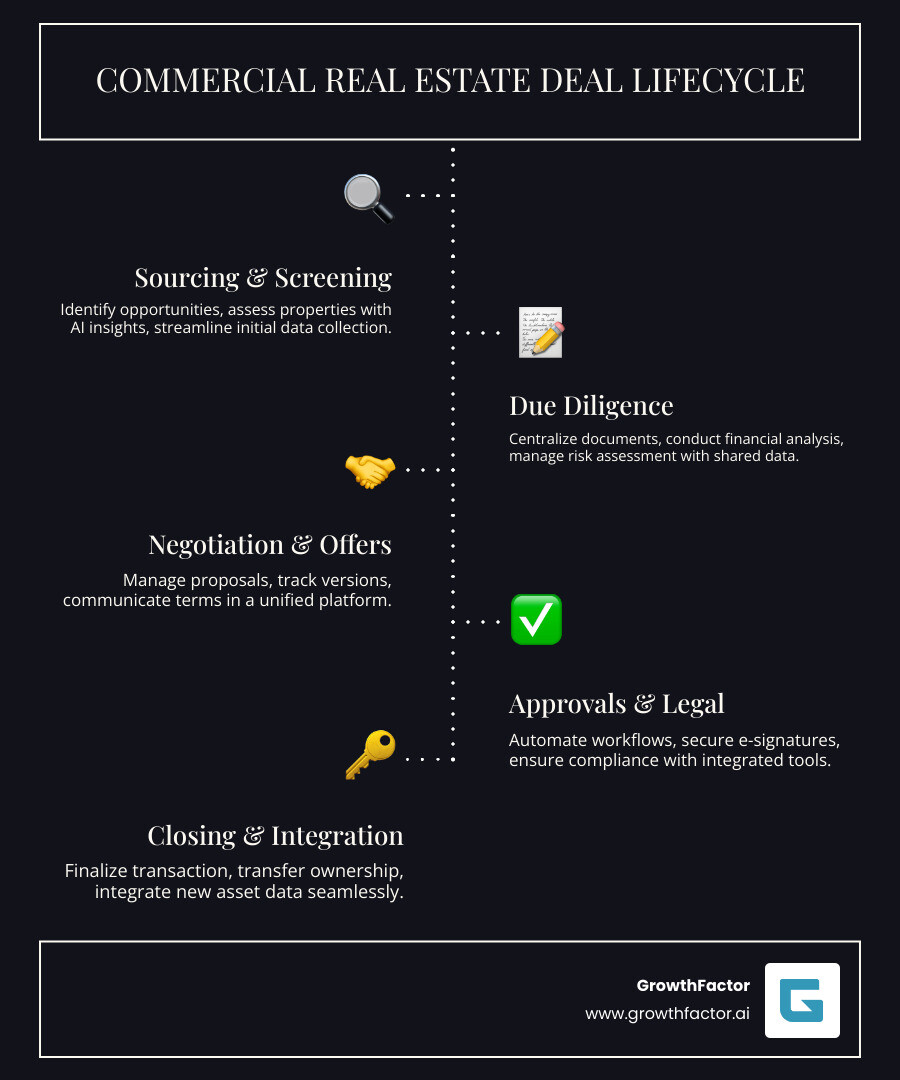
Modern commercial real estate deal management software represents a fundamental shift in how transactions are executed. Instead of patching over manual processes, these platforms redesign the CRE deal lifecycle around a centralized system that supports every stage—from sourcing and underwriting to negotiation and close.
This evolution delivers three core benefits: improved efficiency, reduced costs, and better risk management. By automating repetitive tasks and centralizing information, teams work with greater speed and precision. Deals move from initial sourcing to close faster, because everyone operates from real-time data rather than static files. Crucially, decisions are driven by analytics rather than gut instinct, as platforms surface the latest financials, comps, and market indicators in one place. This comprehensive, data-first approach is foundational to commercial real estate automation.
Centralizing Data for Real-Time Insights
The concept of a "single source of truth" is the bedrock of efficient CRE deal management. By centralizing all deal-related data within a dedicated platform, organizations eliminate the fragmentation that plagues traditional workflows. Property details, financial models, communication logs, legal documents, and approvals all live in one secure, searchable system.
Centralization open ups real-time pipeline visibility. A Deal Dashboard offers a dynamic, visual overview of every opportunity rather than a static spreadsheet. Teams can immediately see where each deal sits in the process, identify bottlenecks, and reallocate resources as needed. Robust, customizable reporting goes well beyond basic summaries, supporting detailed deal metrics, budget comparisons, and historical performance analysis. Many solutions even compare deal economics to budgets and prior leases automatically.
This data-rich environment ensures that decisions about acquisitions and leases—from New York to Boston—are grounded in the most current information available. It also supports more accurate forecasting and scenario analysis, providing the depth of insight needed for sophisticated real estate data insights.
Enhancing Stakeholder Collaboration
Effective collaboration is the engine of successful CRE deals, and technology transforms how stakeholders interact. Modern commercial real estate deal management software provides a unified workspace where brokers, lawyers, investors, and internal teams can work together seamlessly, regardless of location across the United States.
Transparent approval workflows replace ad hoc email chases. Documents move through predefined digital approval chains with clear visibility into who needs to act next, which reduces delays and enforces accountability. Real-time notifications keep everyone aligned on updates, task assignments, and deadlines so key steps are not overlooked.
Leading platforms support dynamic document generation, redlining, and integrated electronic signatures in a secure environment, eliminating manual routing and version confusion. Mobile-friendly, browser-independent access means teams can enter and track deals, view property stacking plans, and coordinate with leasing colleagues from the field. By centralizing communication and tasks, these tools create a more cohesive, efficient deal environment and meaningfully accelerate closings, as detailed in our insights on deal tracking software.
What Features Matter Most in CRE Deal Management Software?
When evaluating commercial real estate deal management software, the goal is not to find a digital filing cabinet but a comprehensive toolkit that supports the entire lifecycle of a CRE transaction. The best solutions combine pipeline visibility, collaboration, automation, and analytics into a single, integrated experience.
Key capabilities to prioritize include:
- Pipeline Management & Deal Tracking: Visualizing and managing the full deal flow.
- Document Management: Secure storage, generation, and e-signing of critical documents.
- Reporting & Analytics: Data-driven insights into performance and trends.
- CRM Capabilities: Managing contacts, relationships, and lead nurturing.
- Workflow Automation: Streamlining repetitive tasks and approvals.
- Collaboration Tools: Centralized communication across all stakeholders.
- Mobile Accessibility: Full deal access from any device.
- AI-Powered Insights: Faster screening and smarter analysis.
- Integration Capabilities: Connecting with other core CRE systems.
Pipeline and Deal Tracking Capabilities
At the heart of effective commercial real estate deal management software are pipeline and deal tracking features that provide a clear, real-time view of every opportunity. Visual deal stages simplify complex workflows into intuitive graphics, so teams can instantly see which opportunities are in sourcing, underwriting, due diligence, negotiation, or closing.
Intuitive deal entry ensures that new opportunities are captured quickly and accurately, minimizing administrative effort. The best platforms accelerate deal cycles with structured workflows, guided data entry, and intelligent deal analysis. Activity feeds log all interactions and changes related to a deal, creating a reliable audit trail.
Automated alerts flag upcoming deadlines, expiring contingencies, and stalled approvals so nothing falls through the cracks. For retail real estate, integrated tour scheduling is especially valuable, allowing property visits to be planned and tracked within the same system. Robust task tracking assigns responsibilities and due dates, improving accountability across leasing, legal, finance, and asset management teams. Comprehensive Real Estate Deal Tracking Software brings these elements together into a single, coordinated workflow across US operations.
The Role of AI and Automation in modern commercial real estate deal management software
Artificial Intelligence (AI) and automation are reshaping commercial real estate deal management software, changing how teams identify, evaluate, and close transactions. AI-generated insights can dramatically accelerate deal screening by delivering instant property, market, and tenant analyses. Instead of manually combing through reports, AI can surface relevant comps, summarize nearby tenant mixes, and highlight risk indicators in seconds.
This enables fractional real estate analysts and internal teams to focus on higher-value tasks, de-risking site selection and compressing early-stage timelines. Automation also extends to routine but critical tasks such as document creation. Platforms now use AI agents to research and assemble branded deal documents—financing memos, investment packages, credit memos—in minutes. These agents collaborate with users to refine assumptions and language, supporting accuracy and brand consistency.
Beyond document workflows, AI-powered features include predictive analytics that forecast market trends or rent trajectories, AI-based lead scoring to prioritize the most promising opportunities, and automated follow-ups that maintain client engagement without constant manual effort. AI-driven CRMs allow teams to accomplish more while dedicating their time to closing deals and building relationships. These capabilities reduce administrative overhead and deepen insight, as explored in our AI for Commercial Real Estate Guide and resources on AI-Driven Decision Making.
Integrated Platforms vs. Standalone Tools
In the evolving landscape of commercial real estate deal management software, organizations often face a choice between integrated, end-to-end platforms and a collection of standalone tools. For complex CRE transactions in the US, integrated platforms typically offer greater operational and strategic advantages.
Integrated solutions provide a seamless flow of information across the entire deal lifecycle. Some platforms pair deal tracking with marketing and leasing capabilities, enabling teams to boost occupancy with automated listings, branded collateral, and centralized availability management in a single CRE system. Once a property or space is ready, it can be marketed and managed without leaving the deal environment.
Many integrated platforms also incorporate legal and compliance modules. They can generate lease documents from templates and clause libraries, route them through clear approval workflows, and capture e-signatures in one secure workspace. When leases are executed, data can sync automatically with property management or ERP systems, instantly notifying relevant teams and eliminating duplicate entry. This holistic approach—detailed in our Commercial Real Estate Software Guide 2025 and discussions of latest CRE tech trends—delivers efficiency, transparency, and trust that are difficult to match with disconnected tools.
Security, Compliance, and the Future of CRE Tech
In the high-stakes world of commercial real estate, platforms handle sensitive financial data, proprietary deal terms, and confidential client information. Security and compliance are therefore non-negotiable when evaluating commercial real estate deal management software. A viable solution must protect against cyber threats, support regulatory requirements, and provide the auditability institutional investors expect.
At the same time, the CRE technology landscape is evolving rapidly. Innovations in AI, analytics, and digital collaboration are changing expectations around speed, transparency, and insight. Understanding where the market is headed helps teams choose solutions that are not only robust today but adaptable as their portfolios and strategies grow.
Key Security and Compliance Considerations
Protecting deal data starts with enterprise-grade security. For CRE organizations, this goes far beyond strong passwords and basic encryption. We look for commercial real estate deal management software that demonstrates mature security practices backed by independent audits.
SOC 1 and SOC 2 Type II compliance are important benchmarks, signaling that a provider maintains rigorous controls over security, availability, processing integrity, confidentiality, and privacy. Leading vendors pair these certifications with comprehensive security programs that include encryption, access management, vulnerability scanning, and secure development practices.
Core technical safeguards typically include encryption in transit and at rest to protect sensitive information, granular access controls that limit who can view or edit specific data, and secure document storage in hardened data centers. Features like two-factor authentication add another barrier for unauthorized users, while detailed audit trails support internal reviews and regulatory inquiries. These measures are critical for maintaining data integrity and meeting expectations across US markets, from Massachusetts to the rest of the country, as described in our data processing addendum.
The Future Outlook for commercial real estate deal management software
The future of commercial real estate deal management software is marked by deeper AI integration, richer data, and more connected ecosystems. Emerging capabilities will move from descriptive reporting toward predictive and prescriptive guidance, helping teams anticipate opportunities and risks before they materialize.
AI will increasingly support proactive portfolio and deal strategy—flagging emerging markets, identifying underperforming locations, and monitoring real-time economic indicators. The idea of a digital global marketplace for the built world is gaining momentum, suggesting more transparent and standardized ways to list, evaluate, and transact CRE assets.
Mobile capabilities will continue to expand so that brokers and asset managers can access full-featured tools—not just light versions—on any device. Analytics will become more granular and scenario-driven, enabling users to test assumptions and understand how individual deals affect broader portfolio performance. Automation will handle an ever-larger share of routine work, freeing real estate professionals to focus on relationships and high-impact decisions. These trends, highlighted in industry conversations such as the Innovator Forum, point toward a more efficient, intelligent, and interconnected CRE technology ecosystem.
Frequently Asked Questions about CRE Deal Management Software
How does deal management software improve the speed of closing deals?
Commercial real estate deal management software dramatically improves the speed of closing deals by addressing several key bottlenecks inherent in traditional processes. Firstly, it automates workflows, replacing manual, time-consuming steps with streamlined, digital processes. This includes everything from initial lead qualification to final contract approvals, accelerating deal cycles through powerful workflows and intelligent analysis.
Secondly, by centralizing all communication and documentation, the software ensures that all stakeholders have instant access to the latest information, eliminating delays caused by information silos or scattered email threads. This real-time data access allows for faster decisions, as decision-makers no longer have to wait for reports or reconcile conflicting data. Thirdly, it streamlines document generation and approvals, often with built-in templates, redlining tools, and electronic signature capabilities. This reduces legal costs and significantly accelerates the creation and execution of critical paperwork. Finally, by reducing manual errors through automation and standardized processes, the software minimizes the need for corrections and revisions, ensuring a smoother path to closing. This comprehensive approach means deals move from sourcing to close with unprecedented velocity.
What is the difference between a CRE CRM and deal management software?
While often overlapping and sometimes integrated, a commercial real estate CRM (Customer Relationship Management) and commercial real estate deal management software serve distinct primary purposes. A CRM focuses predominantly on managing client relationships and nurturing leads. It's designed to track interactions with prospects and clients, manage communication history, segment audiences, and automate marketing efforts. Its core strength lies in building and maintaining relationships, ensuring that no lead is lost and every client feels valued. We dig into this further in our Commercial Property CRM guide.
Deal management software, on the other hand, focuses on the entire transaction lifecycle from sourcing to closing. It's about the execution of the deal itself: tracking stages, managing tasks, handling documents, facilitating approvals, and analyzing performance metrics specific to the transaction. While it might include some CRM-like features for managing contacts related to a deal, its main objective is the efficient progression and completion of the transaction. Many modern platforms, however, combine both functionalities, creating an end-to-end solution that acts as a well-rounded CRM tool while also providing complete deal pipeline oversight. This integrated approach offers the best of both worlds, ensuring robust client management alongside efficient deal execution.
How does this software support portfolio management?
Commercial real estate deal management software plays a crucial role in supporting effective portfolio management by providing a comprehensive and integrated view of assets and their performance. Firstly, it offers a 360-degree view of assets, allowing us to track each property's status within the context of ongoing deals. This includes insights into current leases, upcoming expirations, and potential new opportunities.
The software tracks leases and expirations with precision, sending automated alerts for renewals or vacancies, which is vital for proactive asset management. By centralizing deal data, it enables us to analyze portfolio performance against key metrics like Net Effective Rent (NER) and Internal Rate of Return (IRR), understanding how individual deals contribute to the overall health of our portfolio. These platforms offer robust reporting capabilities, including budget comparisons and customizable pipeline reports, and allow teams to track companies with multiple leases for a complete client view.
Furthermore, by providing data-driven insights and robust reporting, the software helps identify new investment opportunities within the existing portfolio or in target markets. It allows us to simulate different scenarios, evaluate the impact of potential deals on overall portfolio performance, and make smarter, more informed investment decisions. This integration of deal-level data into a broader portfolio strategy is indispensable for optimizing returns and managing risk effectively, a concept we explore in our Commercial Real Estate Portfolio Management resources.
Conclusion
Traditional, manual approaches to commercial real estate deal management—scattered spreadsheets, siloed data, and email-driven workflows—are no longer sufficient for a fast-moving, analytics-driven market. They create misalignment, obscure risk, and slow deal cycles at precisely the moment when speed and clarity are competitive advantages.
Advanced commercial real estate deal management software addresses these challenges by centralizing data, structuring collaboration, and embedding analytics and automation into every stage of the deal lifecycle. From sourcing and screening to negotiation and close, modern platforms replace friction with transparency and repeatable, data-driven processes. AI further amplifies these benefits by accelerating site screening, automating document creation, and supporting more accurate forecasting.
At GrowthFactor, our AI-improved platform and fractional real estate analyst services are purpose-built to de-risk CRE site selection and simplify deal tracking for teams across the US, including markets like Boston and Cambridge. By embracing sophisticated deal management software, retail and commercial real estate organizations can turn complex transactions into consistent, scalable successes. We invite you to explore our Deal Dashboard to see how we can help your team close smarter and faster.
Citations
The human algorithm
Request Your demo
Schedule meeting
Or submit your information below and we'll be in touch to schedule.