
The Smart Investor's Edge: Leveraging Real Estate Market Intelligence
Why Real Estate Market Intelligence Is Critical for Success
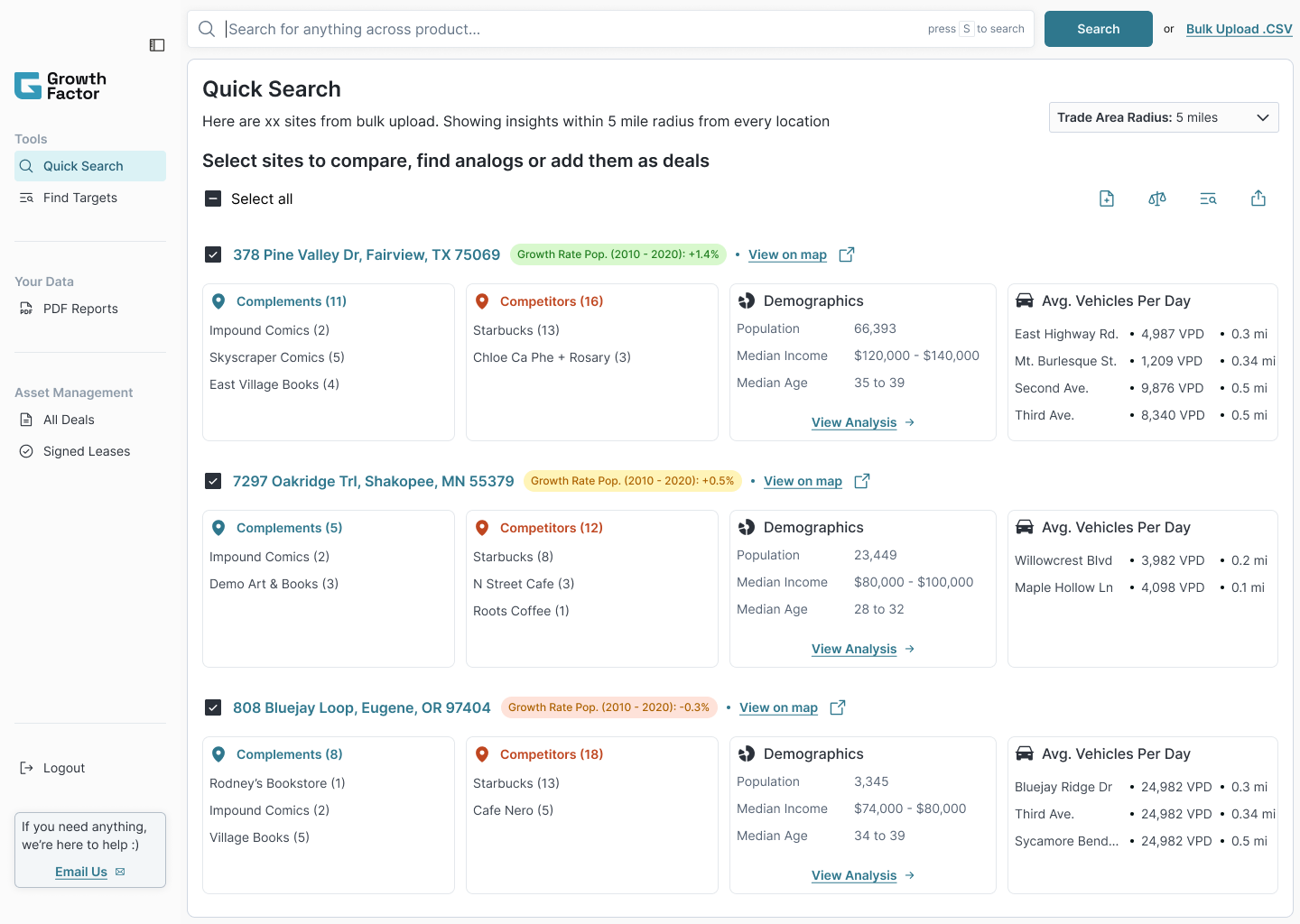
Real estate market intelligence is the systematic collection, analysis, and application of comprehensive data to inform strategic property market decisions. It encompasses:
- Data Sources: Transaction records, demographic trends, economic indicators, and MLS listings.
- Key Metrics: Inventory levels, days on market, price trends, and absorption rates.
- Applications: Site selection, investment analysis, pricing strategies, and risk assessment.
- Technology: AI-powered analytics, predictive modeling, and real-time data platforms.
- Impact: Professionals using market intelligence achieve better outcomes; loan officers with access to comprehensive data produce 1.9x the loan volume of those without it.
The real estate industry has changed. A decade ago, site selection relied on gut instinct and limited reports. Today, the gap between guessing and using comprehensive market intelligence is wider than ever.
Growing retailers face the challenge of evaluating hundreds of potential sites with lean teams and high stakes. Each location decision represents millions in capital and years of commitment. Without robust real estate market intelligence, each choice is a gamble, not a calculated strategy.
The data proves this shift. Industry research shows 95% of U.S. households are covered by transaction databases with over 1.3 TB of data. Yet many organizations still use outdated methods, leaving opportunities untapped.
The stakes are high for retail expansion. A successful location depends on understanding subtle market dynamics that only comprehensive intelligence reveals, such as shopper traffic, competitive density, and demographic shifts. Traditional methods cannot capture this complexity at the speed modern business demands.
I'm Clyde Christian Anderson, founder of GrowthFactor.ai. My journey in retail real estate began in warehouses and led to leading site selection initiatives. I experienced the frustration of making high-stakes decisions without adequate data, which inspired me to build tools that democratize sophisticated location analysis for growing retailers.

Foundations of Real Estate Market Intelligence

Not long ago, real estate decisions involved driving neighborhoods, talking to locals, and spreading paper maps across a table. This intuitive, time-consuming approach is now risky in fast-moving markets where the cost of being wrong is higher than ever. Real estate market intelligence has thus evolved from a luxury to a fundamental requirement for success.
What is Real Estate Market Intelligence and Why is it Crucial?
Real estate market intelligence is the process of gathering, analyzing, and applying comprehensive property market data to make confident decisions. Its impact is measurable and dramatic, creating a significant competitive advantage.
This intelligence is essential for several reasons:
- Competitive Advantage: Spot opportunities and analyze pricing strategies before competitors.
- Risk Mitigation: Identify warning signs in inventory levels, absorption rates, or demographic shifts to protect capital.
- Opportunity Identification: Uncover emerging neighborhoods, market gaps, and new sources of demand by analyzing the right data points.
- Strategic Planning: Base development pipelines and acquisition strategies on verified data, not guesswork. Understanding Data Analytics Real Estate is key to this shift.
- Informed Decisions: Move from asking "What do we think?" to "What does the data tell us?"
The Evolution of Market Analysis
The shift from gut feelings to data-driven decisions has been profound. Traditional analysis relied on backward-looking information like old tax records and sales data, making it easy to miss market shifts. The digital revolution brought more data online, but many organizations struggled to find meaningful patterns in the noise.
The real change came with Big Data and advanced analytics. Modern platforms now process vast amounts of information, refreshing data weekly to identify patterns a human analyst would miss. This has moved the industry from lagging indicators to real-time intelligence. Instead of learning what happened last quarter, you can understand what's happening now and what's likely to happen next. Predictive analytics spot trends before they become obvious, allowing for strategic action rather than reaction.
This evolution is accelerating, with today's tools offering capabilities that seemed like science fiction a decade ago. For a comprehensive look at these trends, explore our Real Estate Market Trends Complete Guide. Professionals winning today are not just more experienced; they are better equipped with real estate market intelligence that turns uncertainty into opportunity.
The Anatomy of Comprehensive Market Intelligence
Comprehensive real estate market intelligence assembles a complete picture of the market by drawing from multiple data sources and analyzing key metrics. Layering property details over demographic, economic, and transactional patterns reveals opportunities and risks that would otherwise remain invisible.
Key Components of Real-estate Market Intelligence
A robust intelligence framework requires understanding essential data components:
- Property-level data: The foundation, including details like square footage, age, condition, and ownership history. Granular data on tens of thousands of properties helps clarify performance.
- Transaction data: Reveals current market activity through sales, leases, and mortgages. Comprehensive databases with millions of entries allow for confident pattern recognition.
- Demographic data: Answers who the market serves by analyzing population characteristics like age, income, and spending patterns to predict demand.
- Economic indicators: Provide broader context. Interest rates, employment figures, and GDP growth shape real estate demand and help anticipate market shifts.
- Location data: Modern geospatial analysis examines foot traffic, proximity to amenities, and competitive density. This data explains why one location outperforms another. For more on this, see our Commercial Property Data Guide.
Primary Data Sources and Metrics
Intelligence comes from a blend of public and proprietary sources:
- Public records: County and state agencies provide essential data on ownership, transfers, and tax assessments.
- MLS data: A key resource for residential listings, pending sales, and recent transactions.
- Proprietary data platforms: Specialized companies collect, clean, and enrich data from hundreds of sources, offering comprehensive coverage that is impossible to replicate manually.
- Government statistics: The Census Bureau and the National Association of REALTORS® offer demographic snapshots and housing statistics, including key indicators like existing-home sales and affordability indexes. Explore their offerings at Housing Statistics and Real Estate Market Trends from NAR.
Once gathered, data is analyzed using key metrics:
- Inventory levels: Indicates supply and whether it's a buyer's or seller's market.
- Days on Market (DOM): Reveals demand intensity. A low DOM suggests strong buyer interest.
- Price reductions: Offers insight into seller expectations versus market reality.
- Absorption rates: Measures market velocity, or how quickly available properties are sold or leased.
- Rental rate growth and occupancy: Critical for commercial properties, these metrics impact revenue and reveal demand strength.
Understanding these components is the foundation of effective Real Estate Data Intelligence, turning information into actionable insight.
Strategic Applications: Turning Data into Decisions

Real estate market intelligence transforms abstract data into concrete strategies custom to specific business goals. Different industry players use this intelligence in unique ways to drive results.
For Developers and Builders
Market intelligence is crucial for developers. GrowthFactor's AI platform and analyst services remove the guesswork from site selection by analyzing demographics, foot traffic, and competitive density. Our Site Selection Analysis Guide details this process.
Intelligence also powers a comprehensive Real Estate Feasibility Study, ensuring a project is financially viable by clarifying demand, pricing, and competition. Other applications include:
- Product Mix Optimization: Use demographic and income data to build what the market wants.
- Demand Forecasting: Anticipate market shifts by tracking job growth, migration, and affordability trends.
- Competitor Analysis: Understand what other developers are building to position your project effectively.
For Investors and Asset Managers
For investors, market intelligence provides a significant advantage. Our AI for Asset Managers solution processes vast datasets to quickly surface undervalued assets.
It is also essential for:
- Portfolio Optimization: Identify underperforming properties and strategically redeploy capital for maximum returns, a process detailed in our guide to Real Estate Portfolio Optimization.
- Risk Assessment: Spot early signs of market volatility and model economic scenarios to make calculated, informed risks.
- Market Entry and Exit Strategies: Use data to determine the optimal time to buy and sell, maximizing returns as explored in our guide on Real Estate Investment AI.
For Lenders and Agents
Lenders and agents use market intelligence to gain a competitive edge.
- Competitive Benchmarking: Top lenders use intelligence to compare performance, identify growth opportunities, and see which products are gaining market share.
- Identifying Top Agent Partners: Lenders can find high-performing agents by tracking their deal closures and performance trends.
- Borrower Engagement: Anticipate when financed properties might re-enter the market to proactively engage with past clients.
- Pricing Strategies: Agents can use real-time data on inventory and DOM to price properties accurately, building client trust and achieving faster sales.
- Market Positioning: Providing clients with detailed, current market reports establishes agents as local experts. Our AI for Real Estate Brokers streamlines this process.
Across all applications, market intelligence becomes a practical tool that drives measurable results.
The Tech Revolution: AI's Impact on Market Intelligence

Artificial Intelligence and machine learning are changing raw data into powerful fuel for decision-making, rewriting the playbook for real estate market intelligence. AI processes millions of data points in real-time, spotting patterns invisible to the human eye and predicting future market movements with remarkable precision. What once took weeks now happens in minutes.
The Role of AI and Machine Learning
AI brings the power of automated data analysis to the industry, replacing hours of manual spreadsheet work with continuous, accurate analysis. Our guide on Automated Market Analysis Best Practices explores this shift.
Key AI capabilities include:
- Predictive Analytics: Machine learning models examine historical data to forecast future market conditions, a forward-looking capability central to our Market Demand Forecasting Complete Guide.
- Forecasting Models: Sophisticated models generate multiple scenarios to help manage uncertainty by showing what could happen under various conditions.
- Anomaly Detection: AI flags unusual patterns, like a sudden spike in property searches or a shift in DOM, providing an early warning system for risks and opportunities.
At GrowthFactor, we build these AI capabilities into our platform, making sophisticated analysis accessible. Our fractional real estate analyst services combine this technology with human expertise for optimal results.
AI-Powered Location Intelligence
AI provides superhuman vision for understanding location. Geospatial analysis powered by AI can evaluate thousands of potential sites against dozens of criteria in seconds, forming the foundation of Real Estate Location Intelligence.
AI has dramatically evolved trade area analysis, using actual movement patterns and shopping behaviors to define precise areas. For retail, foot traffic patterns are now measurable and predictable. AI also excels at data visualization, turning complex data into intuitive, interactive maps and dashboards.
GrowthFactor makes this AI-powered location intelligence practical and accessible. Our platform streamlines the process, delivering actionable insights for one site or hundreds. Explore how this works in our AI Site Selection Complete Guide. The tech revolution is here; the question is how quickly you can integrate these tools into your workflow.
The Future of Real Estate Intelligence
The world of real estate market intelligence is constantly evolving, driven by new technologies and a growing awareness of data responsibility. Understanding future trends and challenges is essential for staying competitive.
Current Trends and Future Outlook
Several key developments are making market intelligence more powerful and accessible:
- Hyper-local Analysis: The focus is shifting from city-wide insights to granular, block-by-block data that reveals micro-market characteristics.
- Real-time Data Feeds: The new standard is daily or weekly data refreshes, allowing professionals to react to market shifts as they happen.
- Integration of ESG Data: Environmental, Social, and Governance factors are being woven into property valuations and investment decisions, reflecting a growing concern for sustainability and social impact.
- Increased Accessibility: Subscription-based models and user-friendly platforms are making sophisticated tools available to smaller firms. GrowthFactor's tiered plans are designed to meet varied needs and budgets.
- Predictive Economic and Housing Insights: Advanced platforms now pair housing data with economic realities to forecast where the market is headed. Resources like Research and Insights from Fannie Mae exemplify this forward-looking approach.
Navigating Challenges and Ethical Considerations
As intelligence tools become more powerful, we face several important challenges:
- Data Accuracy and Quality: Ensuring data is accurate, complete, and reliable is critical for making sound decisions. The best platforms invest heavily in data cleaning and verification.
- Data Privacy Concerns: Handling sensitive location and demographic data requires a strong ethical commitment to privacy and responsible, anonymized use.
- Cost of Intelligence Tools: While the ROI is high, the upfront cost can be a barrier. Flexible pricing models, like those offered by GrowthFactor, help make these tools more accessible.
- The Digital Divide: Unequal access to technology and data infrastructure across regions remains a concern that the industry must work to bridge.
- Algorithmic Bias: AI models can perpetuate historical biases present in data. Ensuring fairness and transparency in algorithms is essential. Our Commercial Real Estate AI Guide explores these ethical considerations in depth.
Navigating the future of real estate intelligence requires using the power of data while upholding our ethical responsibilities.
Conclusion
From its foundations to the cutting-edge role of AI, one truth is clear: the days of making property decisions on instinct are over. Professionals who thrive today are those who use real estate market intelligence to build a data-driven strategy.
Market intelligence transforms uncertainty into a clear, actionable roadmap. It helps you mitigate risk, spot opportunities before competitors, and make decisions with confidence. As AI evolves, the gap between the informed and the uncertain will only widen. Mastering these tools today is essential for sustained success.
At GrowthFactor, we put this power in your hands. Our AI-improved platform and fractional real estate analyst services make sophisticated location intelligence accessible for any size business. We offer plans custom to your needs—Core, Growth, and Enterprise—to help you make smarter, faster decisions without complexity.
The intelligence revolution is here. Every day without comprehensive market intelligence is a day of missed opportunities. It's time to move beyond guesswork and gain your competitive edge.
Explore how a professional market evaluation can redefine your approach to the real estate landscape.
Citations
The human algorithm
Request Your demo
Schedule meeting
Or submit your information below and we'll be in touch to schedule.

