
Demographics Decoded: Your Blueprint for Site Selection
What Demographic Site Analysis Actually Means (And Why It Matters)

Demographic site analysis is the process of evaluating statistical population data for a specific geographic area to decide whether a business location is worth pursuing. It looks at who lives, works, and shops near a potential site: their age, income, household size, education, and spending habits.
Here's a quick breakdown of what it covers:
| Factor | What to Look At |
|---|---|
| Population | Density, growth rate, total count |
| Income | Median household income, high-income household concentration |
| Age | Median age, share of families with children, senior population |
| Households | Size, composition, homeownership rate |
| Employment | Job density, commuter flow, daytime population |
| Education | Degree attainment, professional workforce share |
Done right, demographic site analysis tells you whether the people near a site actually match your customer profile, before you sign a lease.
Most location mistakes aren't random. A high-end retailer struggling in a working-class neighborhood, a children's store planted in an empty-nester suburb, a coffee shop that misjudged whether its customers want a quick drive-through or a place to sit and work: these are demographic mismatches. They're predictable, and they're avoidable.
The stakes are real. Retailers often spend $7 to $10 million per new store. Getting the demographic fit wrong doesn't just hurt one location; it ties up capital for years.
I'm Clyde Christian Anderson, Founder and CEO of GrowthFactor.ai, and I've been doing demographic site analysis since I was 15, first in my family's retail business and later in investment banking, where I saw the same costly, fragmented process repeat across the industry. GrowthFactor was built specifically to fix it, combining demographic data, foot traffic, competition, and zoning into one transparent platform so retail teams can make faster, better-informed location decisions.
Demographic site analysis vocabulary:
Why Demographics are the Bedrock of Site Selection
Think of demographics as the foundation of a building. If the foundation is cracked or built on the wrong soil, it doesn't matter how beautiful the storefront looks. Every successful location decision starts with a clear read on the people nearby.
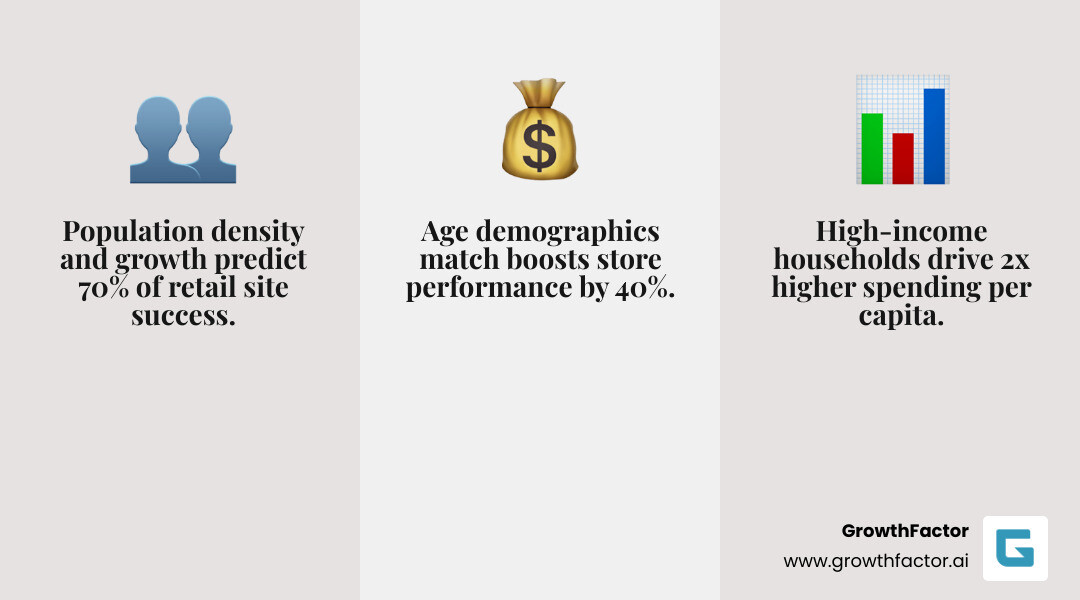
Population density and household growth are just math until you connect them to your model. A high-volume grocery store needs enough households close by to keep inventory moving. A boutique fitness studio usually needs a smaller footprint of higher-income households who will actually pay for monthly memberships. High-income households nearly doubled between 2010 and 2020, and that shift moved the "good markets" for premium brands in ways a lot of teams missed.
You also have to look past what a neighborhood is today. AARP research says most older adults want to age in place. That changes demand for healthcare, accessibility, and the kinds of retail that do well in suburban areas that used to skew younger. If you only take a snapshot, you can miss that a neighborhood is getting older, then wonder why the same product mix stops working five years later.
If you ignore these shifts, you end up overbuilding in the wrong places and underbuilding where demand is quietly stacking up. A Site Demographics Complete Guide helps you spot those pockets earlier. We've watched retailers add $1.6M in cash flow by sticking to the demographic clusters that fit their customer, instead of chasing locations that simply "felt" busy.

Core Components of a Winning Demographic Site Analysis
When we dive into the data, we aren't just looking for a "good" neighborhood. We're looking for a match. Different business models require different demographic "recipes." A discount retailer might thrive in a densely populated, working-class area, while a high-end electronics store needs tech-savvy young professionals with high discretionary income.
| Metric | Urban Site Profile | Suburban Site Profile |
|---|---|---|
| Population Density | High (10,000+ per sq mile) | Moderate (2,000 - 5,000 per sq mile) |
| Median Income | Highly variable by block | Generally stable and higher |
| Household Size | Smaller (1-2 people) | Larger (3-4 people) |
| Commuter Patterns | Public transit / Foot traffic | Car-dependent / Highway access |
Understanding the Retail Site Selection Process means looking at how these components interact. For instance, employment statistics and daytime population are vital for lunch-service restaurants. If a neighborhood has 50,000 residents but they all commute 20 miles away for work, your Tuesday lunch rush will be a ghost town.
Evaluating Income and Spending Potential
Income levels are the most direct indicator of purchasing power, but median income only tells half the story. You need to look at wealth distribution. Are there enough high-income households to support a luxury expansion? Between 2010 and 2020, the doubling of high-income households changed the map for premium retailers.
We also look at the Bureau of Labor Statistics' Consumer Expenditure Survey. This data tells us not just how much money people have, but how they spend it. Do they spend more on dining out or home improvement? This economic indicator is the difference between a site that looks good on paper and one that actually rings the register.
Understanding Age and Life Stages in Demographic Site Analysis
Age is a primary driver of behavior. A neighborhood full of twenty-somethings has different needs than one filled with retirees.
- Youth-Driven Growth: In global markets, countries like India (1.45B people in 2025) and Nigeria are seeing massive youth-driven growth. Nigeria’s population is expected to reach 400 million by 2060. This creates a huge runway for family-oriented retail and education services.
- Aging Populations: Conversely, Japan's population is projected to decline significantly by 2065. In the U.S., the "aging in place" trend means healthcare and accessibility-focused retail are becoming top priorities for site selection.
You can use resources like the Official UN Population Database to see these macro trends, but for a specific site, you need to drill down to the school district level. The presence of high-performing schools is often a magnet for families with high spending potential, even if the median age of the overall city seems older.
A Practical Guide to Conducting Your Analysis
So, how do you actually do it? It isn't about downloading a single PDF report and calling it a day. It’s a step-by-step process of narrowing down the world until you find the perfect corner.
- Define Your Ideal Customer Profile (ICP): Don't just say "everyone." Define the age, income, family status, and even the values of your best customers.
- Map the Trade Area: This isn't just a circle on a map. You have to consider "drive-time" and "walk-time." A river, a highway, or a dangerous intersection can cut a trade area in half.
- Analyze the Competition: Use a platform that shows you where your competitors are. Is the market saturated, or is there a "void" you can fill?
- Tailor Your Inventory: Use the demographic data to decide what goes on the shelves. If the data shows a high concentration of young families, stock more strollers and less fine china.
- Forecast Sales: By modeling traffic and conversion rates against the local population, you can project revenue before you ever break ground.
This Data-Driven Site Selection approach removes the mystery from expansion.
How AI and Big Data Modernize Site Selection
The old way of doing things involved 10 different tools, three spreadsheets, and a lot of guessing. Today, AI and big data have changed the speed of the game. Using AI, expansion teams can evaluate five times more sites than they could with traditional methods.
At GrowthFactor, our AI enables clients to see "glass box" results. We don't just give you a score from 1 to 100; we show you exactly why a site scored that way. Is it because the daytime population is high? Or because the income growth in that specific block group is outperforming the rest of the city? This speed advantage is critical in competitive markets like Boston or Cambridge, where the best sites are gone in days, not weeks.
Moving Beyond Averages with Demographic Site Analysis
Averages are dangerous. A neighborhood with a "median income of $75,000" might actually be composed of 50% people making $150,000 and 50% people making $25,000. Those two groups shop very differently.
To get a true picture, we combine demographics with lifestyle data (psychographics). This tells us how people live, not just who they are. Do they value convenience or sustainability? Are they "eco-conscious hikers" or "busy professionals"? Neighborhood profiling allows us to understand purchasing behavior and mobility patterns with much higher precision. For example, knowing that a specific segment prefers online shopping with in-store pickup can change the entire design of your retail footprint.
Avoiding Common Pitfalls in Your Analysis
Even with good data, teams still make the same avoidable mistakes. Here are the ones we see most often:
- Trusting black-box scores: If a tool says a site is "Green" but can't show the inputs, you can't defend the decision to your board, your franchisees, or your own finance team.
- Relying on stale data: Census data is a solid baseline, but it ages fast. We recommend using providers like EASI Demographics that publish quarterly updates and five-year forecasts.
- Missing commuter flow: A site can look great on residential demographics and still fall flat if everyone leaves at 8:00 AM and comes back at 6:00 PM.
- Finding the right people, then losing to zoning: You can have a perfect match on paper and still hit a wall if zoning doesn't allow your use. GrowthFactor is the first platform with integrated zoning layers so you can catch that early.
For more on how teams pressure-test sites, check out our Site Selection Analysis Guide.
Frequently Asked Questions about Demographic Site Analysis
What is demographic site analysis?
It is the statistical evaluation of population data within a specific geographic area. Businesses use it to make informed location decisions by examining trends in age, income, education, and household composition to ensure a site matches their target customer.
Where can I find reliable demographic data?
Reliable sources include the U.S. Census Bureau (for block-group level data), the Bureau of Labor Statistics (for spending habits), and the United Nations for global trends. For business-ready insights, private providers like EASI Demographics offer more frequent updates and forecasts than public sources.
How does AI improve the site selection process?
AI automates the heavy lifting of data aggregation. It can forecast foot traffic, recognize patterns in consumer behavior that humans might miss, and allow teams to compare hundreds of sites instantly. This leads to faster, more accurate GO/NO-GO decisions.
Conclusion
Demographic site analysis is how you lower the odds of opening a store that never had a real chance.
If you're a big retailer trying to process dozens of submissions a month, speed matters. If you're a growing franchise picking your next ten locations, consistency matters. Either way, the goal is the same: understand whether the people around a site fit what you sell, and prove it with data you can explain.
We built GrowthFactor to replace the old patchwork of PDFs, spreadsheets, and screenshots. It puts demographics, foot traffic, competition, and zoning in one place, with unlimited users and on-demand analyst support.
Ready to see the data behind your next location decision? Explore GrowthFactor solutions and let's find your next winning site together.
Citations
The human algorithm
Request Your demo
Schedule meeting
Or submit your information below and we'll be in touch to schedule.

