
What is a Franchise Opportunity and How Can You Find One
Why Understanding Franchise Opportunities Matters for Your Business Growth

Franchises opportunity represents one of the most proven paths to business ownership, combining the independence of entrepreneurship with the support of an established system. At its core, a franchise enables you to operate a business using a proven format developed by a company (the franchisor), in exchange for fees and adherence to their operating standards.
Key Elements of a Franchise Opportunity:
- Brand Recognition - Instant customer trust through an established name
- Proven Business Model - Tested systems and processes that reduce startup risk
- Training & Support - Initial and ongoing assistance from the franchisor
- Financial Investment - Initial fees ($10,000 to $1,000,000+) plus ongoing royalties (typically 4-10% of gross sales)
- Contractual Obligations - Defined terms, territory rights, and operational requirements
The franchise sector contributes over $800 billion to the U.S. economy annually and supports more than 8.5 million jobs. What makes this model particularly compelling is its success rate of over 80%—significantly higher than independent startups. This is because franchisees receive comprehensive support including operating manuals, site selection assistance, marketing guidance, and access to established supply chains.
However, this support comes with trade-offs. Franchisors maintain control over critical aspects of your business—from site approval and design standards to the products you sell and how you market them. You'll also face ongoing financial obligations beyond your initial investment, including royalty payments and advertising contributions, even during periods when your location isn't profitable.
I'm Clyde Christian Anderson, Founder and CEO of GrowthFactor.ai, where we've helped franchise brands evaluate over 550 new locations with a 99.8% success rate in meeting revenue targets. Throughout my work with franchise systems, I've seen how critical data-driven decision-making is when evaluating franchises opportunity, particularly in site selection—the single factor that can make or break a franchisee's success.
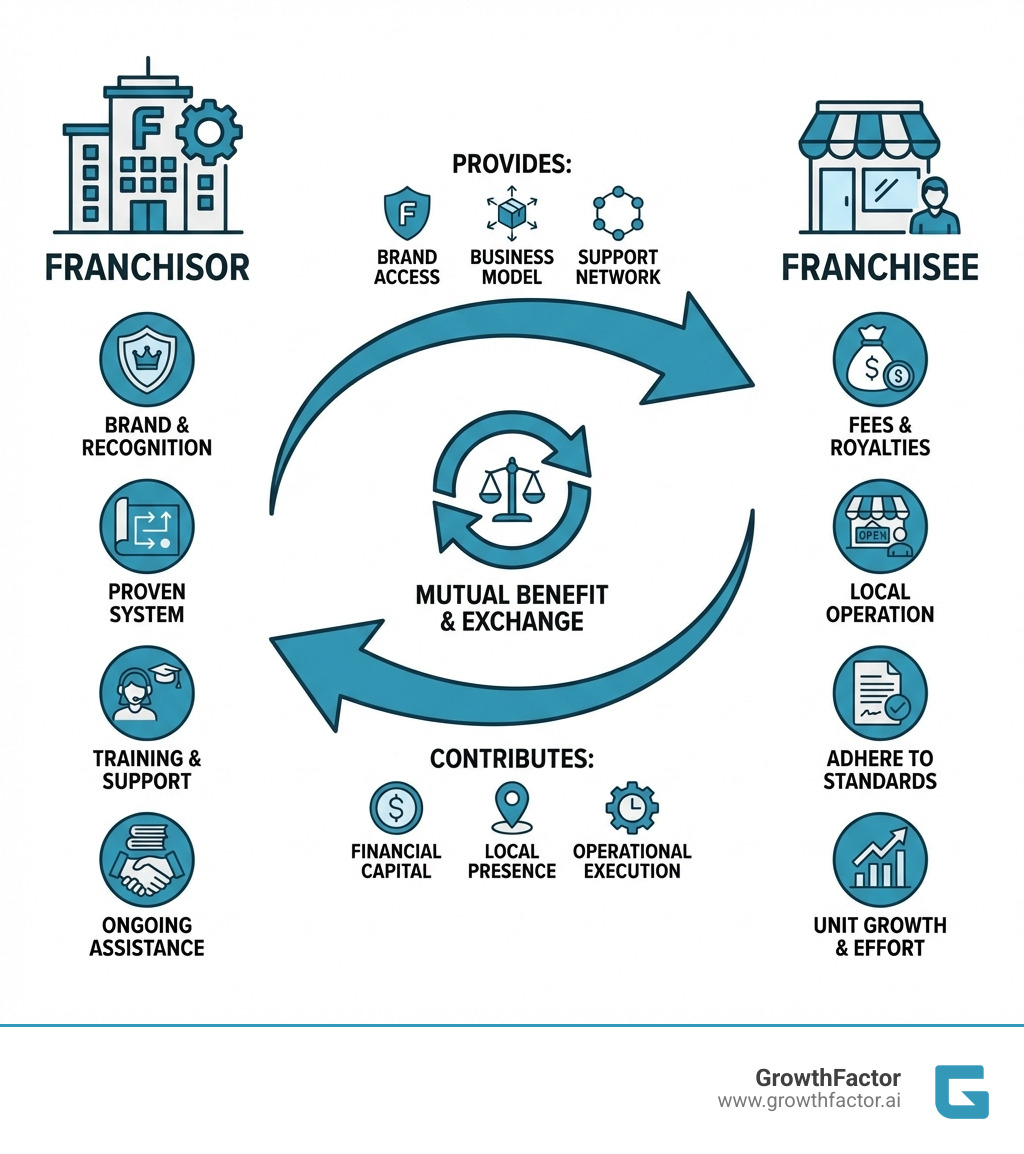
The Anatomy of a Franchise: What's Included?
When we talk about a franchises opportunity, we're discussing more than just buying a business; we're investing in a complete package. This "business-in-a-box" concept is a significant draw for many aspiring entrepreneurs.
At the heart of this package is brand recognition. Imagine opening a restaurant or a retail store, and customers already know and trust your name from day one. That's the power of an established brand. It's like skipping the arduous first few years of building a reputation from scratch. Along with the brand comes a proven business model—systems and processes that have been tested, refined, and shown to work. This includes everything from how to prepare a product to how to manage inventory.
A critical component of this proven model is the provision of operating manuals. These detailed guides cover virtually every aspect of running the business, providing a roadmap for daily operations. As the Federal Trade Commission (FTC) highlights in its A Consumer’s Guide to Buying a Franchise, these manuals are part of the franchisor's commitment to uniformity and quality across all locations.
However, this structured environment also means franchisor controls. These controls are in place to protect the brand's integrity and ensure consistency. They often include:
- Site approval: The franchisor will likely have the final say on your chosen location, ensuring it meets their specific criteria for visibility, traffic, and demographics.
- Design standards: Your outlet's appearance, from its layout to its signage, will need to adhere to the franchisor's specifications.
- Supplier restrictions: You might be required to purchase products or supplies from approved vendors to maintain quality and consistency.
- Operational guidelines: Everything from operating hours to accounting procedures could be dictated by the franchisor.
One of the most appealing aspects of a franchises opportunity is the comprehensive training and support provided. This typically begins with initial training, which can range from a few days to several weeks. For example, a franchise like Pür & Simple offers an intensive 5-week training program, comprising 2 weeks of theoretical and practical training, followed by 3 weeks of on-site assistance during your opening phase. This ensures you're well-versed in their "Breakfast Reinvented®" concept and operational intricacies. Wendy's also provides technical assistance for its franchisees.
Beyond initial setup, ongoing assistance is crucial. Franchisors often offer continuous support, including marketing strategies, operational guidance, and even research and development for new products. Marketing support is a huge advantage, as you benefit from national or regional advertising campaigns, digital marketing, and public relations efforts that would be prohibitively expensive for an independent business.
Finally, every franchises opportunity comes with contractual obligations outlined in the franchise agreement. This legally binding document details the terms of your partnership. Key elements include the franchise agreement term, which commonly runs for about 10 years, though it can extend up to 20 years. It also specifies termination clauses, outlining conditions under which the agreement can be ended, and renewal rights, which explain if and how you can extend your franchise agreement once the initial term expires. It’s vital to understand that renewals are not always guaranteed, and terms may change.
Decoding the Financials of a Franchise Opportunity

Understanding the financial landscape is perhaps the most critical step when exploring a franchises opportunity. It's not just about the sticker price; it's about the entire investment picture, from upfront fees to ongoing contributions.
The first significant cost you'll encounter is the initial franchise fee. This one-time payment grants you the right to use the franchisor's brand, system, and trademarks. While the research indicates this can range from tens of thousands to several hundred thousand dollars, it's just the beginning.
The total investment range for a franchise is much broader, typically spanning from $10,000 to over $1 million, depending heavily on the industry and brand. This total figure encompasses everything from the franchise fee to real estate, build-out costs, equipment, initial inventory, operating licenses, insurance, and the crucial element of working capital—the funds needed to cover initial operating expenses until your business becomes profitable. For instance, while Wendy's requires a minimum liquidity of $2 million USD and a net worth of $5 million USD, Pür & Simple estimates a total development cost between $800,000 and $900,000, with an unencumbered cash requirement of approximately $400,000. These figures highlight the significant capital commitment often required.
Beyond the initial outlay, you'll have ongoing fees that are essential to the franchisor-franchisee relationship. These typically include:
- Royalty fees: These are recurring payments, usually a percentage of your gross sales, paid to the franchisor for continued use of the brand and support. These commonly range from 5% to 10% of gross sales. For example, Pür & Simple charges 5% of gross sales, while Wendy's ranges from 4% to 6%.
- Advertising fees: To maintain brand visibility and marketing efforts, franchisees often contribute to a national or regional advertising fund. These typically hover around 2% to 4% of gross sales. Pür & Simple charges 3%, and Wendy's charges 4%.
- Technology fees: While not always explicitly detailed, many modern franchises also charge fees for proprietary software, point-of-sale systems, or other technological tools that are integral to their operations.
To give us a clearer picture, let's look at some typical investment ranges and fees for different franchise sectors:
| Franchise Sector | Typical Initial Investment Range (USD) | Typical Royalty Fees (% of Gross Sales) | Typical Advertising Fees (% of Gross Sales) |
|---|---|---|---|
| Food Service | $250,000 - $1,500,000+ | 4% - 8% | 2% - 4% |
| Retail | $100,000 - $750,000 | 5% - 7% | 1% - 3% |
| Home Services | $50,000 - $250,000 | 6% - 10% | 0% - 2% |
| Personal Care | $100,000 - $300,000 | 5% - 7% | 0% - 2% |
| Automotive | $200,000 - $800,000 | 5% - 8% | 2% - 4% |
When evaluating a franchises opportunity, it's crucial to consider evaluating potential earnings. The FTC guide emphasizes the importance of Item 19 in the Franchise Disclosure Document (FDD), which contains Financial Performance Representations. However, we must be cautious: "gross sales figures do not reflect profits." It’s essential to look beyond top-line revenue and understand the net profit potential, factoring in all operating costs and ongoing fees. An accountant experienced in franchise matters can be your best friend here, helping you dissect these numbers. For a deeper dive into understanding the financial health and potential of a franchise, exploring Franchise Analytics can provide invaluable insights.
How to Find and Evaluate Your Ideal Franchises Opportunity

Starting on the journey to find your ideal franchises opportunity is exciting, but it requires a structured approach. It's like finding the perfect dance partner – you need to know yourself first!
Our first step is always self-assessment. We need to be brutally honest about our:
- Financial capacity: How much liquid cash do we have for the initial investment and working capital? The FTC guide wisely asks, "How much money do you have to invest? How much money can you afford to lose?"
- Skills and experience: Does the franchise require specific technical expertise or management experience? What unique skills can we bring to the table?
- Personal goals: Why are we considering a franchise? Is it for supplemental income, a career change, or to build a generational business? What kind of work-life balance are we seeking? Pür & Simple, for instance, highlights its 7 a.m. to 3 p.m. operating hours as a key draw for franchisees seeking more family time.
Once we have a clear picture of ourselves, we can start researching options. There are several avenues to explore:
- Online directories: Websites like the International Franchise Association's Franchise Opportunities directories are excellent starting points to browse various industries and investment levels.
- Franchise expos: These events allow us to meet franchisors face-to-face, ask questions, and compare multiple opportunities under one roof.
- Franchise brokers: While they can offer guidance, brokers are typically paid commissions based on the franchise cost, which could influence their recommendations. Always vet them carefully, as the FTC advises.
The core of finding the right franchises opportunity lies in thorough due diligence. This means doing our homework, not just relying on what the franchisor tells us. As a successful franchisee once noted, "Do your homework before investing." This involves:
- Market demand: Is there a genuine need for the franchisor's products or services in our target community? Is it seasonal, or does it generate repeat business?
- Local competition: Who are our competitors, both local and national? How established are they?
- Brand reputation: Is the franchisor's name well-known and respected, or will we have to build market awareness from scratch? We should also check for any consumer or franchisee complaints.
For a more focused search, consider leveraging tools like Franchise Search.
What to Look for in a Franchise Opportunity
When sifting through the myriad of available franchises opportunity options, certain characteristics stand out as indicators of potential success:
- Strong brand: A well-recognized brand with a positive public image reduces our marketing burden and instills immediate customer trust.
- Positive franchisee feedback: The best way to gauge a franchise's health is by speaking directly with current and even former franchisees. Their experiences with profitability, support, and the franchisor relationship are invaluable.
- Comprehensive training: A franchisor committed to our success will provide thorough initial training and continuous educational resources.
- Marketing support: Look for robust national and local marketing programs, as well as assistance with localized campaigns.
- Scalability: If our goal is to grow, the franchise system should offer a clear path for multi-unit ownership or expansion into new territories.
The Role of the Franchise Disclosure Document (FDD)
The Franchise Disclosure Document (FDD) is the holy grail of franchise research. It's a legal document that every franchisor in the U.S. is required to provide to prospective franchisees at least 14 days before any contract is signed or money is exchanged. Think of it as the operating manual for the entire franchise system.
The FDD contains 23 key items, each revealing crucial information about the franchisor and the franchises opportunity:
- Litigation history (Item 3): This section details any lawsuits involving the franchisor or its executives. A pattern of disputes with franchisees could be a red flag.
- Bankruptcy (Item 4): This item discloses any bankruptcy filings by the franchisor or its predecessors, offering insight into their financial stability.
- Costs (Items 5-7): These items break down all fees, including the initial franchise fee, estimated initial investment, and ongoing fees like royalties and advertising contributions. This is where we get the full financial picture.
- Financial statements (Item 21): This includes the franchisor's audited financial statements for the past three years. An accountant can help us interpret these to assess the franchisor's financial health.
Reviewing the FDD carefully is non-negotiable. It's our legal right to have this information, and it's our responsibility to understand it. For a comprehensive breakdown of this vital document, refer to our guide on the Franchise Disclosure Document.
Questions to Ask Current and Former Franchisees
Speaking with current and former franchisees is arguably the most insightful part of due diligence. They offer unfiltered, real-world perspectives. Here are some key questions we should ask:
- How long did it take for your franchise to become profitable?
- What kind of support did you receive from the franchisor, particularly during the initial setup and grand opening? Was it adequate?
- What are the biggest challenges you face in your day-to-day operations?
- How responsive is the franchisor to your concerns or suggestions?
- Do you feel the marketing and advertising fees provide good value?
- What do you wish you had known before buying this franchises opportunity?
- Would you recommend this franchise to a friend or family member? Why or why not?
- If they are a former franchisee, why did they leave the system? What were their biggest frustrations?
- How useful and effective was the training provided by the franchisor?
- Are there any hidden costs or unexpected expenses that significantly impacted your profitability?
Your Roadmap to Launching a Franchise
Once we've identified a promising franchises opportunity and completed our due diligence, the next step is to prepare for launch. This involves several critical phases, from securing financing to setting up our physical location.
Securing financing is often the first hurdle. While some franchisors might offer or facilitate financing programs, most aspiring franchisees will explore external options:
- SBA loans: The U.S. Small Business Administration (SBA) guarantees loans made by commercial lenders, making it easier for small businesses, including franchises, to secure funding.
- Personal capital: Many franchisors, like Wendy's and Pür & Simple, require a significant amount of unencumbered cash or liquid assets from their franchisees. This personal investment demonstrates commitment and financial stability.
Before signing on the dotted line, a thorough legal review of the franchise agreement is paramount. This means hiring a franchise lawyer experienced in federal and state franchise laws. They will help us understand the agreement's complexities, identify potential risks, and clarify our rights and obligations. While franchise agreements are largely standardized, a lawyer can advise on specific negotiation points that might be open for discussion, such as territory protection or renewal terms.
The Critical Step of Site Selection for Your Franchise Opportunity
For many retail and service-based franchises, site selection is not just important—it's critical. As we mentioned earlier, location can make or break a franchisee's success. Even the best franchises opportunity will struggle in a poor location.
The franchisor site approval process is designed to protect both the brand and your investment. They often have sophisticated criteria based on years of experience and market research to identify optimal locations. Our role is to find potential sites that align with these criteria, and then work with the franchisor to secure approval. This process often involves lease negotiation, where an experienced real estate professional or lawyer can help us secure favorable terms.
At GrowthFactor, we believe in data-driven decisions when it comes to site selection. Modern tools go far beyond simply looking at traffic counts. We leverage advanced analytics for:
- Demographic analysis: Understanding the age, income, household composition, and lifestyle of the population around a potential site.
- Competitor analysis: Identifying where our competitors are located and how they are performing.
- Traffic patterns: Not just car counts, but also pedestrian traffic and accessibility.
Our platform, for example, uses AI to analyze market potential and de-risk site selection for franchisors and their partners. We move beyond simple radial rings to sophisticated models that assess site strength based on factors correlated with performance. This means we can help identify "hot spots" within trade areas, guiding franchisees to locations that are statistically more likely to succeed. For more in-depth knowledge on this, our Franchise Site Selection Ultimate Guide is an excellent resource. By using technology, we empower franchisees to make smarter, more informed real estate choices.
Training and Grand Opening
With financing secured and a prime location locked down, the focus shifts to preparing for launch. This phase is heavily supported by the franchisor's expertise.
Franchisor training programs are designed to equip us with all the knowledge and skills needed to operate the business successfully. This usually covers everything from product preparation and customer service to inventory management and marketing. As Pür & Simple demonstrates, training can be a multi-week, multi-faceted experience, ensuring we're fully immersed in the brand's culture and operational standards.
Following training, we'll often receive on-site support during our grand opening period. This hands-on assistance from franchisor representatives helps us iron out any kinks and ensures a smooth launch. Simultaneously, pre-opening marketing efforts will be in full swing, creating buzz and driving initial traffic to our new location. This culminates in the exciting moment of launching the business, where all our hard work and preparation come to fruition.
Frequently Asked Questions about Franchise Opportunities
What are the biggest advantages of a franchise over an independent startup?
Choosing a franchises opportunity over an independent startup offers several compelling advantages:
- Lower risk & Higher success rates: Franchise businesses boast a success rate of over 80%, significantly higher than independent ventures. This is due to the proven business model and established support systems.
- Brand recognition: You immediately benefit from an existing brand, customer loyalty, and a reputation that would take years, if not decades, to build independently.
- Built-in support system: Franchisors provide comprehensive training, ongoing operational guidance, marketing assistance, and access to established supply chains. You're never truly alone.
- Easier financing: Lenders often view franchises as less risky investments due to their proven track record, potentially making it easier to secure loans.
How much money do I really need to start a franchise?
The amount of money required for a franchises opportunity varies widely. The initial investment can range from $10,000 to over $1 million, depending on the industry, brand, and size of the operation. It's crucial to distinguish between the total investment and the liquid cash (or unencumbered cash) required. For instance, Wendy's requires a minimum of $2 million USD in liquid assets and a $5 million USD net worth, whereas Pür & Simple requires approximately $400,000 in unencumbered cash for a total investment between $800,000 and $900,000.
Your best resource for this information is FDD Item 7, which details the estimated initial investment, including the franchise fee, equipment, real estate, working capital, and other startup costs. For those with more modest budgets, there are indeed Cheap Franchise Opportunities available, but always ensure they align with your goals and due diligence.
Can I own more than one franchise unit?
Absolutely! Many franchisors actively encourage and support multi-unit ownership. For example, Wendy's explicitly seeks franchisees with a "growth-driven mindset" interested in "multi-unit opportunities globally." Pür & Simple also highlights that multi-unit opportunities are available.
This often involves area development agreements, where you commit to opening a certain number of units within a defined territory over a specific timeframe. Another option is master franchising, where you purchase the rights to develop and sub-franchise the brand within a large territory, such as an entire state or region. You can Explore Master Franchise Opportunities if you're interested in this larger-scale investment. However, expanding typically requires demonstrating strong performance with your initial unit(s) and having access to adequate capital for reinvestment.
Conclusion
Exploring a franchises opportunity offers a structured and often less risky path to entrepreneurship. We've seen how the "business-in-a-box" model provides invaluable brand recognition, proven systems, and comprehensive support, contributing to a significantly higher success rate than independent startups. However, this comes with important financial commitments and adherence to franchisor controls.
Our journey to finding the right franchises opportunity begins with honest self-assessment, meticulous research through directories and expos, and thorough due diligence—including deep dives into the Franchise Disclosure Document and candid conversations with existing franchisees. The roadmap to launching involves securing financing, navigating legal agreements with expert advice, and critically, making data-driven decisions for site selection.
The right franchises opportunity aligns with our personal goals, financial capacity, and skill set. While the allure of instant brand recognition and built-in support is strong, success hinges on our commitment to the system, our ability to execute locally, and our willingness to accept the partnership. Always leverage professional advice from lawyers and accountants to ensure every decision is well-informed. For franchise brands looking to empower their franchisees with data-driven site selection, explore how to build a smarter Franchise Growth Strategy.
Citations
The human algorithm
Request Your demo
Schedule meeting
Or submit your information below and we'll be in touch to schedule.


