
Unlock the Vault: Discovering Free Franchise Disclosure Documents
Understanding the Franchise Disclosure Document and Where to Find It for Free

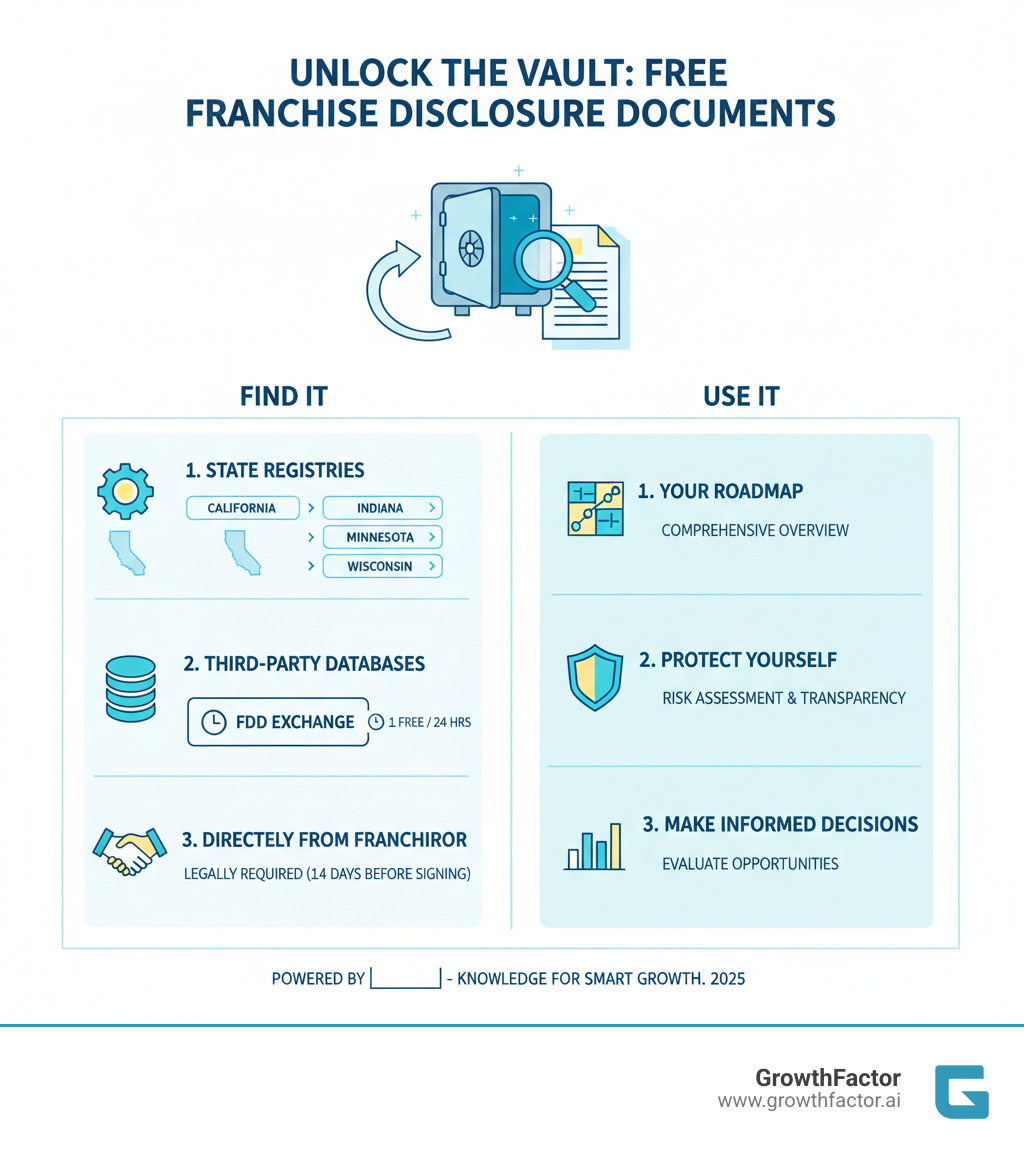
A free franchise disclosure document is available through several official channels, primarily state government portals in California, Indiana, Minnesota, and Wisconsin. These states maintain public registries where you can download FDDs at no cost. You can also request an FDD directly from any franchisor—they're legally required to provide it at least 14 days before you sign anything or pay any fees.
Quick Access Points for Free FDDs:
- California: Department of Financial Protection - Search by franchisor legal name
- Indiana: Secretary of State Portal - Documents from 2019-present
- Minnesota: Commerce Department - Requires Area of Interest selection
- Wisconsin: Department of Financial Institutions - Easiest search interface
- FDD Exchange: One free document every 24 hours with signup
Before investing in a franchise, you must understand what you're buying. The Franchise Disclosure Document (FDD) is your roadmap—a federally mandated document revealing everything from the franchisor's litigation history to estimated startup costs. While franchisors must provide FDDs to serious prospects, they rarely post them publicly, making initial research difficult. This guide shows you how to find these critical documents for free.
Why this matters for retail expansion: Understanding FDD requirements is vital for retail executives managing franchise development or evaluating franchise partnerships as part of a growth strategy.
I'm Clyde Christian Anderson, founder of GrowthFactor.ai. With a career spanning from fast food to managing real estate site selection for retail chains, I've learned that efficiently accessing and analyzing free franchise disclosure documents is crucial for making data-driven decisions.
What is a Franchise Disclosure Document (FDD)?
An FDD is a comprehensive legal document, often over 200 pages, that franchisors must provide to prospective buyers. Its purpose is to protect you by providing transparency into the franchise opportunity.
This requirement stems from the Federal Trade Commission (FTC) Franchise Rule, established in 1978 to combat deceptive practices in the industry. The rule mandates that franchisors disclose material facts in a standardized format. You can review the full regulations here. The FDD replaced the older Uniform Franchise Offering Circular (UFOC) in 2007.
Two key rules to know:
- The 14-Day Rule: Federal law requires franchisors to give you the FDD at least 14 calendar days before you sign any contract or pay any money. This period is for due diligence—use it to review the document, consult a franchise attorney, and speak with current franchisees.
- Annual Updates: Franchisors must update their FDD annually, within 120 days of their fiscal year-end. They must also issue immediate updates if any material changes occur, such as a major lawsuit. This ensures the information is current.
While franchisors must provide an FDD to serious prospects, they are not required to publicly post it. They often treat it as a confidential document, which is why finding a free franchise disclosure document for initial research requires knowing where to look. The state portals we'll cover next leverage public registration requirements to make these documents accessible.
How to Find a Free Franchise Disclosure Document via State Portals
Finding a free franchise disclosure document is a game-changer for initial research, letting you compare opportunities without engaging sales teams. While the FTC doesn't have a central public database, several "registration states" require franchisors to file their FDDs, making them public records.
Four states offer excellent free online access: California, Indiana, Minnesota, and Wisconsin. That a franchisor's FDD will only be in a state's database if they are registered to sell franchises there. Also, search functions can be precise, often requiring the exact legal name.
Step 1: Searching on the California Free FDD Search Portal
California's Department of Financial Protection & Innovation offers a comprehensive database.
- Visit the California Free FDD Search portal.
- Enter the franchisor's exact legal name in the 'Legal Name' box.
- Select "Uniform Franchise Registration Application" from the dropdown menu and click search.
- The portal provides access to FDDs, applications, and other related documents.
Step 2: Using the Indiana Free FDD Search Database
Indiana's portal is user-friendly but has a more limited date range.
- Go to the Indiana Free FDD Search website.
- Choose "Franchise" under the 'Registration Type' filter.
- Enter the franchisor's legal name.
- This portal only contains registrations from 2019 to the present.
Step 3: Navigating the Minnesota Free FDD Search Website
Minnesota's site requires you to be specific to get the best results.
- Visit the Minnesota Free FDD Search portal.
- Select "Franchise Registrations" in the 'Area of Interest' dropdown.
- Enter the franchisor's name. For better results, specify the year and whether it's an "Initial Registration" or "Renewal".
Step 4: Accessing FDDs on the Wisconsin Free FDD Search Site
Wisconsin's portal is widely considered the most straightforward.
- Steer to the Wisconsin Free FDD Search site.
- Type the franchisor's brand or legal name into the 'Name' field and search.
- You can typically download the FDD from the 'Filings Details' page for the specific registration.
Alternative Methods for Finding FDDs
If the franchise you're researching isn't registered in the states with public portals, or if you need older FDDs for historical analysis, state portals aren't your only option. This data is valuable for a competitive Franchise Growth Strategy.
Method 1: Third-Party FDD Databases
Online platforms have built extensive libraries of FDDs, creating searchable repositories that are useful for broad research and comparing concepts over time.
One of the most established is The FDD Exchange. After a free signup at FDD Exchange, you can view one complete FDD every 24 hours at no cost. This is ideal for methodical research and competitive analysis, as it often includes historical versions unavailable elsewhere.
The main trade-off is the one-per-day limit. While the database is large, it may not always have the absolute latest version of an FDD. Premium tiers for unlimited access are also available.
Method 2: Directly Engaging with the Franchisor
The most direct route is to simply ask. Once you express genuine interest, franchisors are legally obligated to provide their FDD. This guarantees you receive the most current version.
- Pros: You get the document straight from the source, complete with all recent updates. It also opens a direct line of communication for questions.
- Cons: This method doesn't scale for early-stage, comparative research. Engaging with multiple franchisors means becoming a sales lead for each, resulting in follow-up calls and emails.
For franchisors conducting competitive intelligence, this method is invaluable for gathering current data on fees, financial performance representations (Item 19), and agreement terms.
How to Analyze an FDD for Smart Investment Decisions
Finding a free franchise disclosure document is just the first step. The real value lies in understanding what's inside. This legal document contains the data you need to make a smart choice, but only if you know how to read it. Whether you're looking at a Restaurant Franchise For Sale or another opportunity, the analysis is critical.

Key Components of a Free Franchise Disclosure Document
Every FDD has 23 standardized items. While you should read the entire document, focus your initial analysis on these key areas:
- Items 1 & 2: The Franchisor and Leadership. Review the experience and background of the team you'll be partnering with.
- Item 3: Litigation. Scrutinize any lawsuits, especially those from other franchisees. A pattern of fraud or misrepresentation claims is a major red flag.
- Item 4: Bankruptcy. Discloses any bankruptcy history for the franchisor or its executives, which could indicate financial instability.
- Items 5 & 6: Fees. Item 5 lists the initial franchise fee, while Item 6 details all ongoing costs like royalties, advertising, and tech fees that will impact your long-term cash flow.
- Item 7: Estimated Initial Investment. This table breaks down all expected startup costs, from real estate to inventory and working capital. Pay close attention to the high and low estimates and the assumptions behind them.
- Items 8-10: Restrictions and Obligations. These sections cover supplier restrictions (which affect your margins), your duties as a franchisee, and financing options.
- Item 11: Franchisor's Assistance. This details the training, marketing, and ongoing support you're buying. It separates franchisors who support their partners from those who just collect checks.
- Item 12: Territory. Defines whether you get an exclusive territory or if the franchisor can open competing locations (including online) nearby.
- Items 13-18: Trademarks, Operations, and Exit. These items cover intellectual property, your operational duties, and the critical rules for renewing, transferring, or terminating your franchise agreement.
- Item 19: Financial Performance Representation (FPR). This optional section provides data on franchisee earnings. If it's included, analyze the data carefully—what does it represent, and what's excluded? If it's blank, you must rely on your own research by talking to other franchisees.
- Item 20: Outlets and Franchisee Information. These tables show franchisee turnover (openings, closings, transfers). High turnover is a sign of systemic problems. This item also provides contact lists for current and former franchisees—a crucial resource for your due diligence.
- Item 21: Financial Statements. The franchisor's audited financial statements for the past three years. Have an accountant review these to assess the franchisor's financial health.
- Item 22: Contracts. Contains the actual franchise agreement and other contracts you will be asked to sign.
- Item 23: Receipt. The page you sign to acknowledge you received the FDD.
Of these, five are absolutely critical for your initial review: Item 7 (Initial Investment), Item 19 (Financial Performance), Item 20 (Outlets and Franchisee Information), Item 3 (Litigation), and Item 21 (Financial Statements).
Red Flags and Common Mistakes to Watch For in a Free Franchise Disclosure Document
Certain warning signs demand closer inspection:
- High Franchisee Turnover (Item 20): If many franchisees are leaving the system (terminating, not renewing), find out why. A high failure rate is a serious warning.
- Excessive Litigation (Item 3): While some lawsuits are normal, a pattern of suits from franchisees alleging fraud or lack of support is a major red flag.
- Missing or Weak Financial Claims (Item 19): Be wary if Item 19 is blank or presents cherry-picked data. Promises made during sales calls should be backed by data in the FDD.
- Weak Franchisor Financials (Item 21): A franchisor that is losing money or is deep in debt may lack the resources to support you long-term.
- Restrictive Territory Rights (Item 12): Ensure you understand your territory rights. You don't want the franchisor opening a competing location or e-commerce channel that cannibalizes your sales.
- Hidden Costs (Items 5, 6, & 7): Look beyond the initial fee. Account for all ongoing royalties, ad funds, and required purchases. Ensure the Item 7 estimate includes enough working capital for your market.
At GrowthFactor, we know data-driven decisions are superior. The FDD provides the data; your job is to analyze it. Once you've done your homework, tools like our AI-powered platform can help franchise development teams make smarter site selection decisions.
Frequently Asked Questions about FDDs
Here are answers to common questions about the free franchise disclosure document.
How often is a Franchise Disclosure Document updated?
Franchisors must update their FDD annually, within 120 days of their fiscal year-end. They must also issue immediate updates if a "material change" occurs, such as a major lawsuit or a change in leadership. Always confirm you have the most recent version.
Are FDD requirements the same outside the U.S.?
No. The FDD is a U.S. requirement under the FTC Franchise Rule. Other countries have their own distinct disclosure laws. For example, Ontario, Canada, is governed by the Arthur Wishart Act. International expansion requires consulting with local franchise law experts.
What's the difference between an FDD and a Franchise Agreement?
This is a critical distinction. The FDD is a pre-sale disclosure document for your due diligence. The Franchise Agreement is the final, legally binding contract you sign to become a franchisee.
The FDD contains a copy of the proposed Franchise Agreement (in Item 22) for you to review beforehand. However, reading the copy is not the same as signing the contract. Always have a qualified franchise attorney review both the FDD and the final agreement before you commit.
Conclusion: From Disclosure to Decision
This guide has shown you how to find and analyze a free franchise disclosure document using state portals, third-party databases, and direct requests. But accessing the FDD is only the start. The real work is in the analysis—scrutinizing the 23 items, especially concerning investment (Item 7), financial health (Item 21), franchisee turnover (Item 20), and litigation (Item 3).
Thorough due diligence is non-negotiable. Use the FDD to ask hard questions, talk to current and former franchisees, and consult with legal and financial advisors. This process transforms the document from a legal requirement into your most powerful decision-making tool.
Once your analysis is complete and you're ready to move forward, the next question is where to open. GrowthFactor's AI-powered platform takes the guesswork out of site selection, helping you identify optimal locations based on market data and competitive landscapes. If you're a franchise development director, our tools can revolutionize your expansion strategy. Learn how we help Franchise Development Directors make smarter, data-driven decisions.
The FDD helps you choose the right opportunity. GrowthFactor helps you find the right place for it to succeed.
Citations
The human algorithm
Request Your demo
Schedule meeting
Or submit your information below and we'll be in touch to schedule.

