
The A to Z of DMAs: Everything You Need to Know About Designated Market Areas
Why Understanding Geographic Markets Matters for Your Expansion Strategy
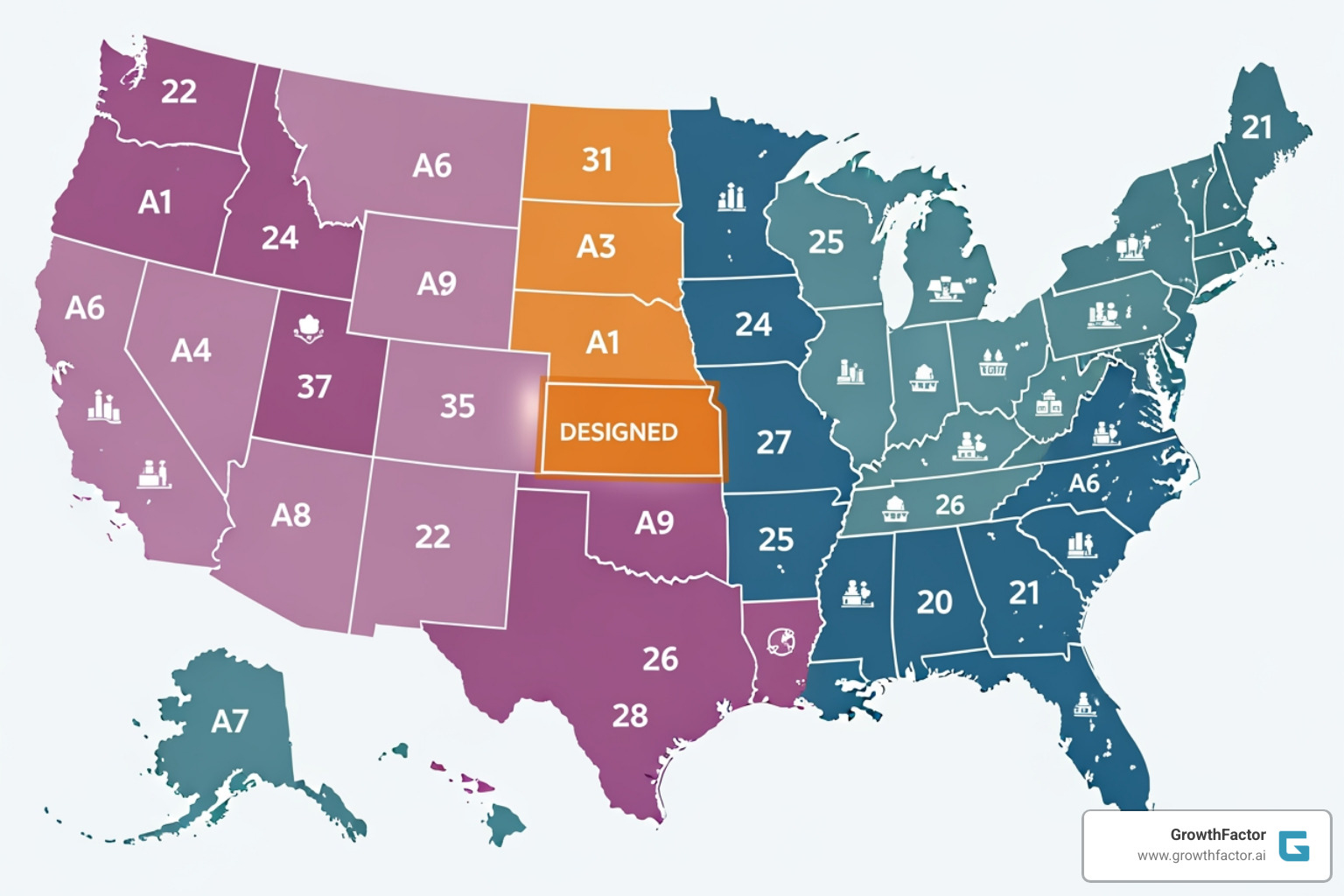
What is a designated market area? A Designated Market Area (DMA) is a geographic region where the population receives the same local television and radio station offerings. Created and maintained by Nielsen, these 210 non-overlapping regions cover the entire continental U.S., Hawaii, and parts of Alaska, grouping counties based on dominant television viewing patterns.
Quick Answer:
- Definition: Geographic regions defined by Nielsen where populations receive similar local broadcast media
- Purpose: Standardized framework for measuring TV audiences and planning media buys
- Structure: 210 regions composed of counties based on dominant TV station viewership
- Who Uses Them: Advertisers, broadcasters, networks, and increasingly, retail expansion teams
- Key Benefit: Enables targeted local marketing and strategic market analysis
As marketers and expansion planners know all too well, communicating in an over-saturated marketplace is like trying to have a conversation in a crowded room. You need to know exactly who you're talking to and how to reach them. That's where geographic market segmentation comes in.
DMAs emerged in the 1950s when television stations proliferated and advertisers needed a standardized way to buy local media. Each DMA represents an area where local TV stations capture a dominant share of viewing. Nielsen ranks these markets annually based on the number of TV households, which directly influences ad inventory pricing and market potential assessment.
But here's what's changed: while DMAs were built for broadcast television, the underlying concept of geographic market definition now powers everything from digital geo-fencing to retail site selection. The framework that once helped advertisers buy TV spots now helps multi-unit retailers identify where to open their next 50 locations.
The distinction matters because your expansion strategy starts with understanding market boundaries. A DMA might tell you that San Francisco, Oakland, and San Jose are one television market. But for a QSR chain evaluating real estate, you need to drill deeper into foot traffic patterns, demographic composition, competitive density, and drive-time trade areas within that broader market. The DMA is the macro view; your site-level analysis is the micro view that determines whether a specific corner in San Jose will generate $2 million or $4 million in annual revenue.
I'm Clyde Christian Anderson, Founder and CEO of GrowthFactor.ai, and I've been working with geographic market data since I was 15, evaluating retail sites in my family's business and later analyzing what is a designated market area for retail expansion as an investment banker and now as a site selection platform builder. This guide will show you exactly how DMAs work, who uses them, and how this geographic framework applies to modern retail expansion decisions.
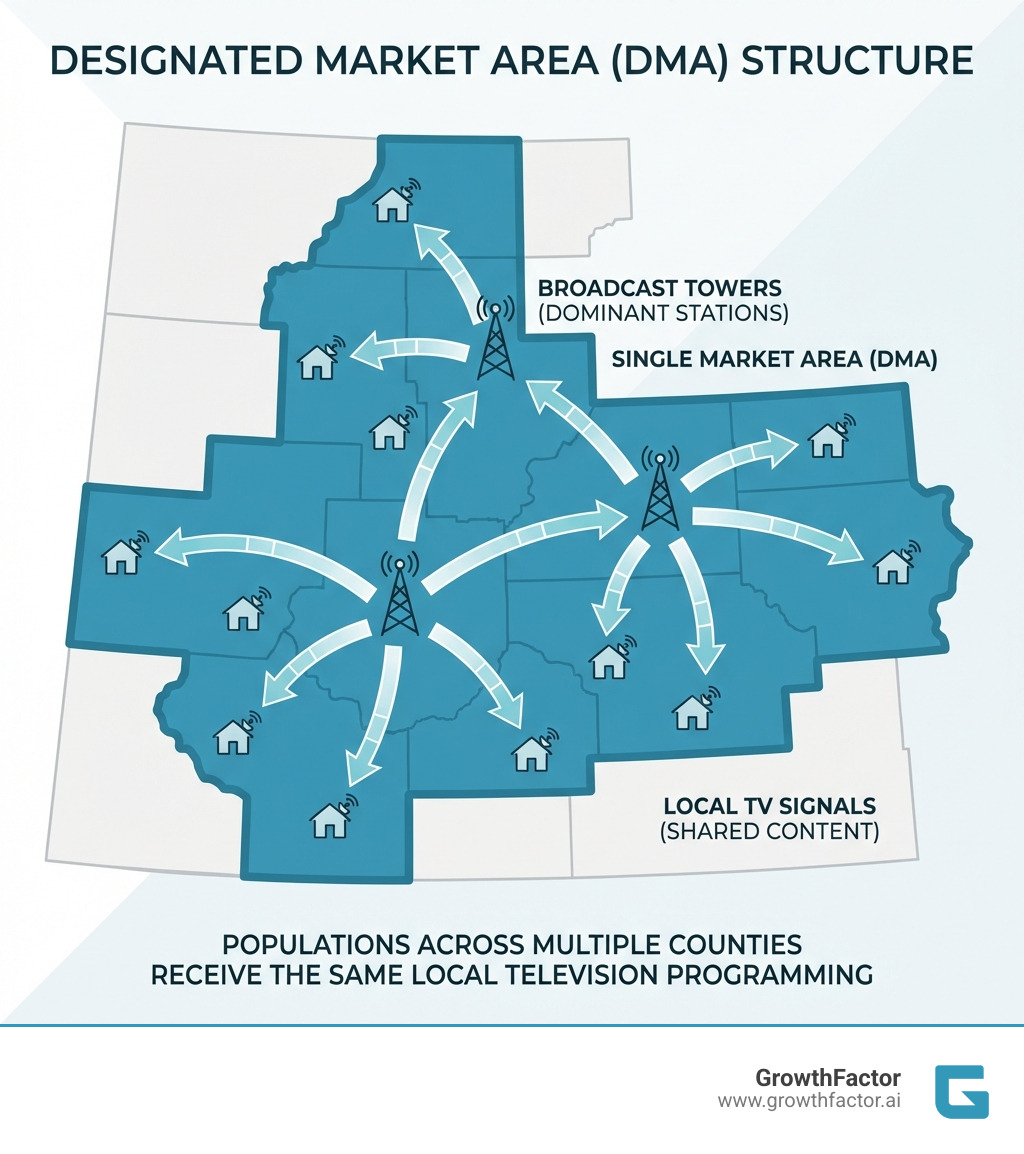
What is a Designated Market Area (DMA) and Who Defines It?
A Designated Market Area (DMA) is a non-overlapping geographic region in the United States where the population receives similar local television and radio content. Nielsen, a global measurement and data analytics company, defines, copyrights, and annually updates these market boundaries. These carefully defined regions serve as the standard geographic units for measuring media audiences across the country. Nielsen owns the trademark for "DMA®," solidifying its role as the authoritative source for these market definitions. There are currently 210 DMA® regions in total, covering the entire continental U.S., Hawaii, and parts of Alaska, ensuring every county is exclusively assigned to one DMA.
The Origin and Structure of DMAs
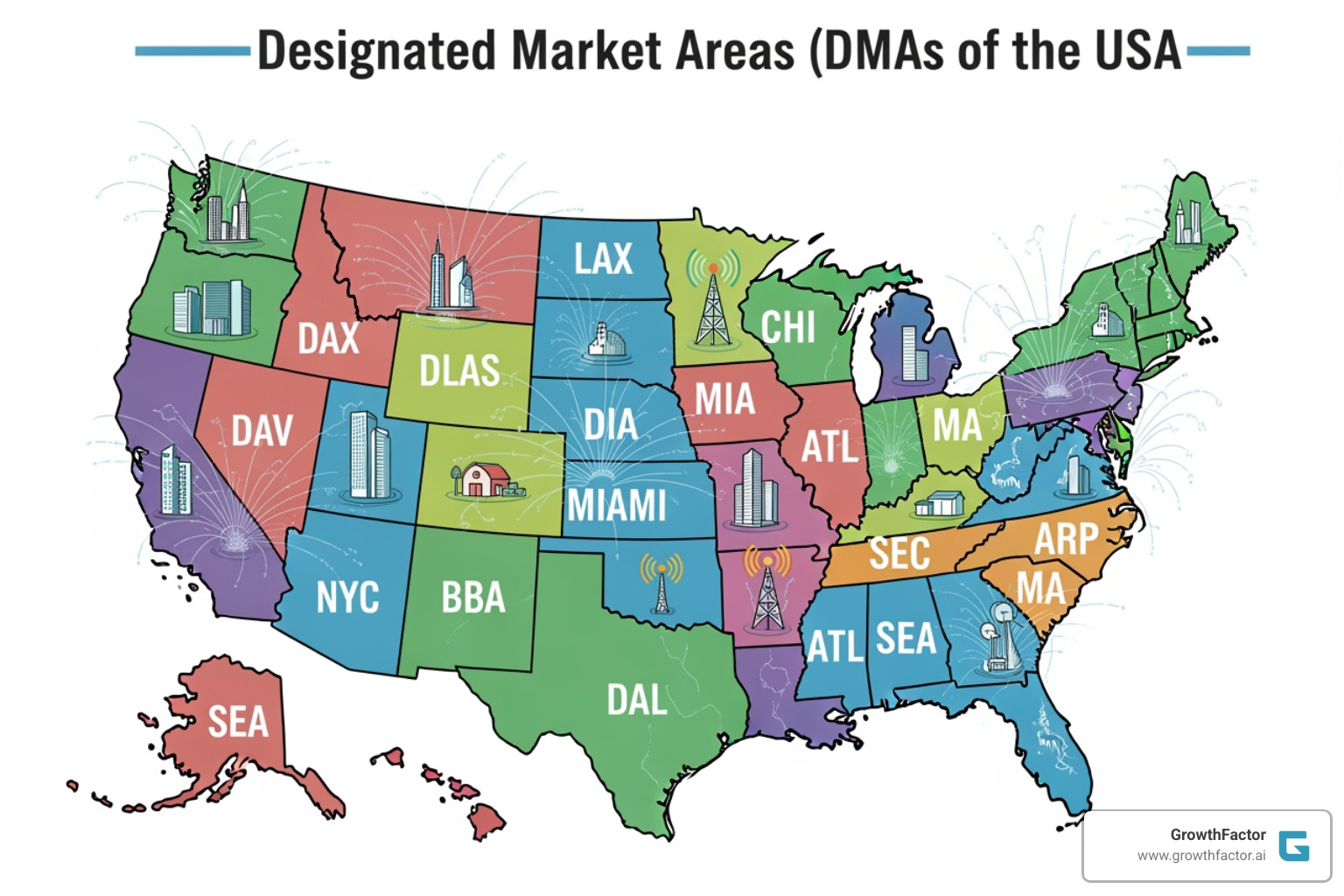
The concept of DMAs originated in the 1950s with the rapid proliferation of television stations, creating an urgent need for standardized audience measurement and precise advertising targeting. Before the widespread adoption of DMAs, media markets were less uniformly defined, making it challenging for advertisers to compare audience reach and effectiveness across different regions. This era saw the rise of systematic approaches to segmenting the American populace for media consumption analysis.
Early attempts at market definition included Arbitron's "Area of Dominant Influence" (ADI), created in 1966. While ADIs served a similar purpose, Nielsen's DMA system ultimately became the industry standard, especially for television. The underlying structure of DMAs involves grouping counties based on which local television stations capture a dominant share of viewing within those areas. This means that if residents in a particular county primarily watch TV stations broadcasting from a major city, that county will likely be grouped into the DMA associated with that city.
Each DMA is not just a geographic outline; it's a dynamic entity that is ranked annually based on the number of TV households within its boundaries. This ranking is a critical metric for media buyers and sellers, as it directly influences the perceived market size, potential audience reach, and ultimately, the pricing of advertising inventory. A higher-ranked DMA, like New York or Los Angeles, signifies a larger audience and therefore, typically higher advertising costs. You can learn more about the broader concept of media markets and their historical evolution here.
How Nielsen Determines and Updates DMA Boundaries
Nielsen's rigorous process for determining and updating DMA boundaries hinges on the principle of "dominant share of viewing." This means they analyze comprehensive data to identify which local television stations are most watched by residents in specific counties. If the majority of viewers in a county consistently tune into stations originating from a particular metropolitan area, that county is assigned to that area's DMA.
To gather this intricate data, Nielsen employs a sophisticated combination of measurement methodologies. This includes both "big data" analytics, which aggregates vast amounts of viewing information from various sources, and "person-level panel measurement," where selected households provide detailed insights into their viewing habits. This dual approach allows Nielsen to capture a nuanced picture of audience behavior, regardless of how or when content is consumed.
The result is a highly standardized and stable geographic framework. Every single county or, in some cases, even split counties within the U.S. is exclusively assigned to one DMA. This ensures there are no overlaps or gaps, providing a clean, comprehensive coverage map of the entire country. Nielsen reviews and updates these boundaries annually to account for shifts in population, viewing patterns, and technological changes. For internal identification and processing, Nielsen assigns a unique 3-digit number to each DMA. This continuous monitoring ensures that DMAs remain relevant and accurate for their primary purpose of media audience measurement and analysis.
How Do Advertisers and Broadcasters Use DMAs?
Advertisers use DMAs to precisely target their campaigns to specific geographic audiences, ensuring their messages resonate locally and their budgets are spent efficiently. Meanwhile, broadcasters and networks rely on DMAs for accurate audience measurement, informing their programming decisions, and establishing fair ad inventory pricing. DMAs provide a standardized framework for media planning, buying, and performance measurement, allowing both sides of the media equation to operate with shared, reliable data.
The Role of DMAs in Media Planning and Buying
DMAs are the unsung heroes of effective media planning and buying, allowing advertisers to move beyond a one-size-fits-all national strategy and accept a more localized approach. Imagine trying to sell winter coats in Miami and swimsuits in Boston during January—without geographic targeting, your ad spend would be as effective as a screen door on a submarine. DMAs prevent this kind of waste by enabling highly focused campaigns.
Here's how DMAs help advertisers with media planning and buying, and the benefits they offer for targeted advertising:
- Geographic Targeting: DMAs allow us to focus campaigns on specific geographic areas where our target audience is most likely to reside or engage. This precision ensures that our message reaches the right people in the right place.
- Efficient Budget Allocation: By understanding the unique characteristics and audience size of each DMA, we can strategically allocate marketing budgets. This means balancing high-impact campaigns in larger markets with custom efforts in smaller regions, maximizing return on investment and minimizing wasted impressions.
- Custom Messaging: DMAs provide the granular data needed to align advertising messages with local preferences, cultural nuances, and regional events. A campaign for a new restaurant chain in Boston, for example, might emphasize different aspects than one for the same chain in Los Angeles.
- Performance Benchmarking: The standardized nature of DMAs offers a consistent framework for comparing advertising campaign performance across different regions. This allows us to identify which markets are performing best and to refine strategies for underperforming areas.
- Optimized Media Placement: DMAs inform decisions about ad placement timing and location within a market, based on local viewing habits and consumption patterns. This ensures ads are seen when and where they're most impactful.
DMAs empower advertisers to accept hyper-local strategies, leveraging geographically segmented data that goes far beyond a national view. This deep understanding of specific market dynamics is crucial for cutting through the noise and making every ad dollar count.
Why DMAs are Essential for Broadcasters and Networks
For broadcasters and networks, DMAs are the very foundation of their operational and financial models. They are key geographic regions defined for television audience analysis, acting as the primary lens through which they understand their viewership, program content, and monetize their offerings.
DMAs help determine local audience measurement, which is critical for understanding who is watching what, and where. This data directly informs local programming decisions; for instance, a news station in the Boston DMA will tailor its content to local events and interests, rather than national news alone. DMAs also provide context for market size and reach, helping networks assess the potential viewership for their shows and the overall value of their local affiliates.
Furthermore, DMAs play a significant role in ad inventory pricing. Stations in larger, higher-ranked DMAs can command higher rates for their advertising slots due to their broader reach and larger audience pools. It's simple supply and demand, informed by Nielsen's DMA data.
Beyond advertising, DMAs are integral to regulatory compliance, particularly concerning cable and satellite carriage rules. The Federal Communications Commission (FCC) uses geographic market definitions to regulate broadcast, cable, and satellite transmissions. These regulations include "must-carry" rules, which obligate cable and satellite providers to carry local broadcast television stations in a particular market. Without a clear definition of these local markets, such regulations would be impossible to enforce. The FCC's regulations on Television Market Areas, which we'll discuss further, are closely intertwined with the DMA concept for these purposes.
Are DMAs Still Relevant in the Age of Digital and Retail Expansion?
Yes, DMAs remain highly relevant, serving as a foundational geographic segmentation framework that informs digital advertising geo-targeting, streaming content distribution, and strategic physical retail expansion decisions. While their origins are rooted in traditional broadcast media, the underlying principle of segmenting populations into distinct geographic markets based on shared media consumption or demographic characteristics is more powerful than ever. We might be watching content on our phones instead of a living room TV, but where we live still largely dictates the local news we care about, the businesses we frequent, and the localized ads we encounter. The concept of a DMA simply provides a common language for these local distinctions.
From Broadcast TV to Digital Geo-Fencing
The evolution of media consumption from traditional broadcast TV to digital platforms has not diminished the relevance of DMAs; rather, it has transformed their application. The principles that governed local TV advertising now directly translate to the digital field, powering sophisticated geo-targeting strategies.
For example, the same geographic boundaries of a DMA that define a local TV market are now used to create digital "geo-fences." These virtual perimeters allow advertisers to target online ads, social media campaigns, and mobile notifications to users whose IP addresses or mobile location data place them within a specific DMA. This ensures that digital marketing efforts, much like their broadcast predecessors, are hyper-localized and relevant to the audience's physical location.
This shift enables powerful cross-channel marketing, allowing businesses to coordinate campaigns that reach the same target audience across both traditional and digital media within a specific market. Furthermore, DMAs provide a framework for measuring online-to-offline conversion, helping businesses understand how digital ads viewed within a certain DMA translate into foot traffic or sales at physical locations in that same area. Even streaming services, while global in reach, often use DMA-like segmentation for localized advertising and content distribution, demonstrating the enduring value of these geographic definitions.
Using Market Areas for Modern Site Selection
For multi-unit retailers and franchises, DMAs provide a crucial starting point for understanding broad regional markets. However, in retail site selection, a DMA is often just the tip of the iceberg. While it offers a valuable macro view of a market's media consumption and general population, successful expansion requires drilling down much further.
At GrowthFactor, we understand that while a DMA might identify a large market like Boston, MA, for example, the real work begins when you analyze the specific neighborhoods, streets, and even corners within that DMA. This means going beyond media consumption data to analyze a rich mix of localized information:
- Demographics: Understanding the age, income, household size, and lifestyle of potential customers within a specific trade area.
- Foot Traffic: Quantifying the number of people passing by a potential site, their patterns, and how they interact with nearby businesses. Our Foot Traffic Analytics solutions provide crucial insights here.
- Competitive Landscape: Identifying existing competitors, their market share, and potential gaps in the market—often referred to as Whitespace analysis.
- Zoning and Infrastructure: Crucial practical details that determine if a site is even viable for a specific type of business.
- Drive-Time Analysis: Understanding how far customers are willing to travel to reach a location.
Our platform, GrowthFactor, excels at taking the broad strokes of a DMA and painting a detailed picture for data-driven site selection. We replace the patchwork of disconnected tools that expansion teams often juggle, like spreadsheets, GIS software, and various data providers, with one unified platform. This allows our users to see exactly why a site scores high or low with what we call "glass box transparency," a stark contrast to the "black box" competitors. All the necessary data—demographics, foot traffic, competition, zoning, and drive-time analysis—is in one place, enabling comprehensive retail site selection analysis and robust Location Intelligence. This integrated approach helps our clients evaluate thousands of sites efficiently, changing market areas into actionable opportunities.
DMA vs. CMA vs. TMA: Understanding Key Differences
While often used interchangeably with "media market," a Designated Market Area (DMA) has a specific definition that differs from other geographic market classifications like Canada's Census Metropolitan Area (CMA) or the Federal Communications Commission's (FCC) Television Market Area (TMA). It's easy to get these acronyms tangled, but understanding their distinct purposes and defining bodies is crucial for accurate market analysis.
Here's a quick comparison:
| Criteria | DMA | CMA | TMA |
|---|---|---|---|
| Defining Body | Nielsen | Statistics Canada | Federal Communications Commission (FCC) |
| Primary Use | TV/Radio Audience Measurement | Census & Economic Analysis | Cable/Satellite Regulation |
| Geographic Basis | Counties with dominant TV viewership | Adjacent municipalities around a population center | Group of counties served by TV stations |
| Country | United States | Canada | United States |
Understanding what is a Designated Market Area vs. a CMA
A Designated Market Area (DMA) is Nielsen's proprietary term for a media market in the U.S., primarily focused on television viewership and advertising. In contrast, a Census Metropolitan Area (CMA) is a Canadian geographic unit defined by Statistics Canada for statistical purposes, centered around a population core.
The key difference lies in their purpose and geographic scope. DMAs are designed to measure media consumption and define advertising markets across the United States. They group counties based on the dominant television signals received by residents.
CMAs, on the other hand, are Canadian constructs used by Statistics Canada for census data collection, economic analysis, and demographic profiling. A CMA is typically formed by one or more adjacent municipalities centered around a population center that has a total population of at least 100,000, of which 50,000 or more live in the core. While CMAs can also determine what content Canadian radio listeners receive, their primary role is statistical and economic, rather than media measurement. You can read more about the definition of a CMA here. It's a fundamental distinction between how the U.S. and Canada segment their populations for different analytical needs.
Understanding what is a Designated Market Area vs. a TMA
A Designated Market Area (DMA) is Nielsen's proprietary term for a US television market used for audience measurement and advertising, whereas a Television Market Area (TMA) is a term used by the Federal Communications Commission (FCC) to define a group of counties served by TV stations for regulatory purposes, specifically concerning broadcast, cable, and satellite transmissions. While both deal with television markets in the U.S., their creators and primary functions differ significantly.
DMAs are commercial constructs, designed by Nielsen to provide a standardized framework for media buyers and sellers. They are the currency of television advertising. TMAs, conversely, are governmental definitions. The FCC uses TMAs, as outlined in 47 CFR § 76.51, to regulate various aspects of the broadcast industry. These include:
- Cable and Satellite Carriage Rules: TMAs are critical for determining "must-carry" rules, which dictate which local broadcast stations cable and satellite providers are obligated to include in their lineups.
- Rebroadcasting Rights: They help define the geographic limits within which a station has exclusive rights to its signal.
- Local Market Definition: The FCC uses TMAs to define "local markets" for various provisions, including retransmission consent, distant signals, and significantly viewed status.
Historically, the FCC relied on Nielsen's annual Station Index Directory for DMA determinations relevant to these regulatory functions. However, as Nielsen updated its publications, the FCC formally updated its rules in late 2022 to use Nielsen's Local TV Station Information Report (specifically the October edition from two years prior to each triennial carriage election) as the successor publication for DMA determinations for cable and satellite carriage purposes. This highlights the close, yet distinct, relationship between Nielsen's commercial DMA definitions and the FCC's regulatory TMAs. The FCC's definition of TMA and its usage can be explored further on their website.
Frequently Asked Questions about Designated Market Areas
How many DMAs are there in the United States?
There are currently 210 Designated Market Areas (DMAs) in the U.S., covering the entire continental United States, Hawaii, and parts of Alaska. Nielsen reviews and updates these annually to reflect changes in population and viewing habits.
Can a single DMA cross state lines?
Yes, many DMAs are composed of counties from multiple states. For example, the New York, NY DMA famously includes counties not only in New York but also in New Jersey, Connecticut, and even parts of Pennsylvania. This reflects the reality of media consumption, where signals can easily cross state borders.
What is the largest DMA?
The largest DMA by number of TV households is New York, NY. DMAs are ranked annually based on this metric, and this ranking is crucial for determining advertising costs and assessing market potential for media buyers and sellers.
What is the difference between a DMA and a radio market?
While DMAs are primarily based on television viewership and are defined by Nielsen (210 markets), radio markets are typically smaller and more numerous. Nielsen Audio (formerly Arbitron) maintains 302 Radio Metros in the United States. Radio markets are generally smaller than TV DMAs due to the more limited broadcast power restrictions and signal range of radio stations compared to television signals, especially those amplified by cable.
How are DMAs used in politics?
Political campaigns use DMAs extensively to plan and buy local television advertising, ensuring their messages reach voters in specific districts and regions efficiently. By targeting specific DMAs, campaigns can focus their spending on competitive areas, tailor messages to local concerns, and track the effectiveness of their advertising efforts among key voter segments.
Conclusion: From Media Markets to Strategic Growth
Understanding what is a designated market area is fundamental for anyone operating in advertising, media, or marketing. It’s the original framework for geographic targeting, providing a standardized, consistent language to discuss and measure local audiences across the United States.
Today, this concept extends far beyond television, influencing digital strategies and physical expansion. For multi-unit retailers and franchises like those we partner with at GrowthFactor, a DMA is just the starting point. While DMAs offer valuable macro-level insights into regional markets, true strategic growth planning requires layering this broad view with granular data on demographics, competition, and consumer behavior at a hyper-local level.
At GrowthFactor, we empower businesses to move from understanding what a DMA is to making confident, data-driven expansion decisions within and across these markets. Our platform consolidates all necessary data—from foot traffic and demographics to zoning and competitive analysis—into one unified, transparent view. This "glass box transparency" allows our users to see exactly why a site is a good fit, unlike the opaque black-box solutions offered by others. We help transform a simple market map into a powerful tool for identifying high-potential locations and accelerating growth. To see how your business can leverage this level of insight, explore our Market Evaluation services.
Citations
The human algorithm
Request Your demo
Schedule meeting
Or submit your information below and we'll be in touch to schedule.