
Forecasting Annual Sales: The Top-Down Approach Explained
Why a Top-Down Sales Forecast Matters for Strategic Growth

A top down sales forecast is a strategic method of estimating future revenue by starting with the total addressable market and working downward. Instead of building projections from individual deals, you begin with the big picture—industry size, market trends, and competitive positioning—then calculate what portion of that market you can realistically capture.
Here's how top-down forecasting works in 3 steps:
- Identify the Total Addressable Market (TAM) - Calculate the total revenue opportunity in your industry or market segment.
- Estimate Your Market Share - Determine what percentage of that market you can realistically capture.
- Apply the Formula - Sales Forecast = (Total Addressable Market × Market Share %) + Adjustments.
When to use top-down forecasting:
- Entering new markets with limited historical data
- Strategic planning and annual budgeting
- Investor presentations and fundraising
- Launching new product lines
- High-level goal setting
Key advantages: Fast to implement, provides strategic market context, aligns teams around shared goals.
Key limitations: Can lack granular accuracy, relies heavily on market research, may miss operational realities.
Imagine your board asks for a revenue forecast for a new market. With no historical sales data or pipeline, a bottom-up approach is impossible. This is exactly when a top down sales forecast becomes your most valuable planning tool.
For retail chains, this method is powerful for evaluating new regions or store formats. It helps you assess market opportunity and set targets before committing resources like signing a lease.
However, relying solely on this method is risky. Poor forecasting accuracy can lead to 26% higher sales and marketing costs, 18% longer sales cycles, and 31% higher sales team turnover. Ignoring ground-level realities can be costly, as one company found when it lost 17% of its market share in two quarters.
The solution is to understand when to use top-down forecasting and when to combine it with more granular approaches. This guide provides a complete framework, from the core formula to implementation, helping you build forecasts that balance strategic vision with market reality.
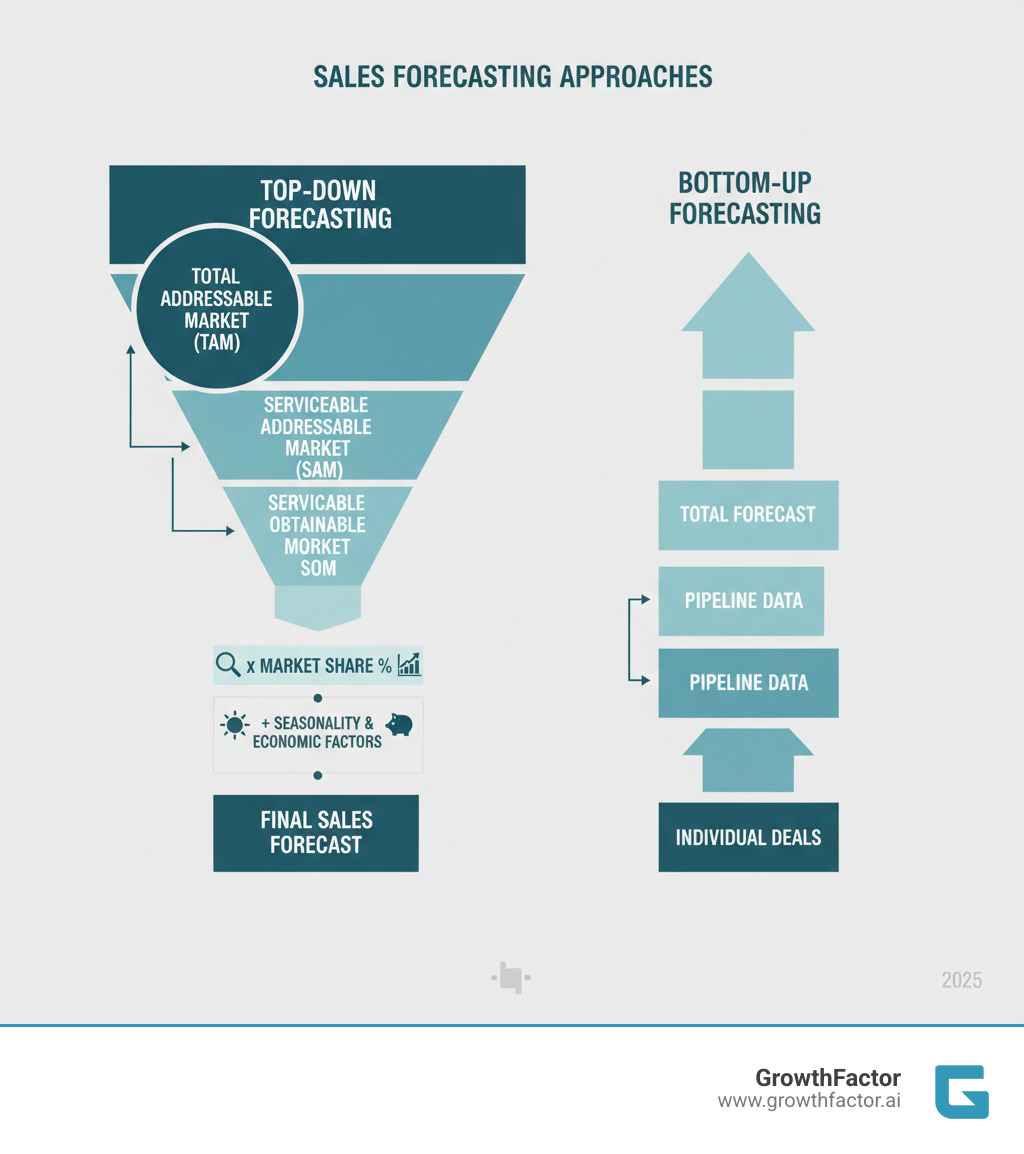
Key terms for top down sales forecast:
Understanding the Top-Down Sales Forecast: From Market to Revenue
When you need a fast answer on revenue potential in a new market, the top down sales forecast is your strategic compass.
What is Top-Down Forecasting?
Think of top-down forecasting as starting with a satellite view of the landscape before zooming in. This macro-to-micro approach begins with the broadest market perspective—industry size, economic trends, consumer spending—then narrows down to determine your realistic share. It's valuable for strategic decisions without detailed historical data, such as a Market Entry Strategy into an unfamiliar region. It also aligns executive vision with market reality for high-level goal setting and investor presentations.
The Core Formula and Its Components
The core formula is refreshingly straightforward:
Sales Forecast = (Total Addressable Market × Market Share) + Adjustments

Understanding each component is key:
The Total Addressable Market (TAM) represents the complete revenue opportunity if you captured every customer. For a coffee shop chain, TAM might be all coffee purchases in a city. Understanding your Total Addressable Market is the first step.
Since TAM is often too broad, it's refined into the Serviceable Available Market (SAM)—the portion you can serve with your business model—and the Serviceable Obtainable Market (SOM), the portion you can realistically capture given your competition and resources. SOM is your true target.
Market share percentage reflects your competitive strength, brand recognition, and marketing. A new store might capture 3-5% of local spending, while an established brand could project 8-12%.
Finally, adjustments account for real-world conditions like economic forecasts, seasonality, and marketing campaigns, turning a baseline calculation into a realistic projection.
Top-Down vs. Bottom-Up Forecasting: A Tale of Two Perspectives
Understanding when to use each forecasting method—or how to combine them—is key to creating projections that drive growth.
| Feature | Top-Down Forecasting | Bottom-Up Forecasting |
|---|---|---|
| Starting Point | Begins with total market size and company goals, then breaks down to specifics (macro to micro) | Starts with individual sales activities and customer data, then aggregates upward (micro to macro) |
| Primary Focus | Strategic planning, market potential, high-level targets, competitive positioning | Operational planning, resource allocation, day-to-day execution, individual performance |
| Data Sources | Industry reports, economic indicators, demographic data, market research, competitive analysis | CRM data, sales pipeline, historical win rates, individual rep performance, customer purchase patterns |
| Best Use Cases | New market entry, product launches, annual budgeting, investor presentations, strategic alignment, pre-revenue startups | Short-term tactical planning, inventory management, quota setting, resource allocation, established businesses with rich historical data |
| Advantages | Fast implementation, strategic alignment, provides market context, ideal when detailed data doesn't exist | High accuracy for near-term, detailed operational insights, increased team accountability, adapts quickly to changes |
| Disadvantages | Can lack granularity, potential for over-optimism, relies heavily on assumptions, may miss operational realities | Time-consuming, requires extensive clean data, risk of "sandbagging," can miss broader market trends |
| Key Question | "How much of this market can we realistically capture?" | "How many units can our team actually sell given current pipeline and capacity?" |
A top down sales forecast is strategic, asking what portion of the market you can win. It's ideal for big-picture decisions where speed is essential.
Conversely, bottom-up forecasting, as detailed by the Corporate Finance Institute, builds from individual sales activities. It excels at operational planning and short-term accuracy.
Using the wrong method is costly. The smartest operators use both. When your top-down analysis suggests $2M in revenue but your bottom-up capacity shows only $1.2M, you've identified a critical strategic gap to address.
How to Build a Top-Down Forecast in 5 Steps
This guide walks through creating a top down sales forecast in five practical steps.
Step 1: Market Sizing (TAM, SAM, and SOM)
The foundation of a solid forecast is understanding the size of your opportunity. This three-level framework narrows the focus from theoretical to achievable.

Total Addressable Market (TAM) is the entire opportunity, like all grocery spending in the Northeast. Gather this data from industry reports and government economic data.
Serviceable Available Market (SAM) is the slice of TAM that fits your business model, such as premium running shoes within the larger athletic footwear market.
Serviceable Obtainable Market (SOM) is your realistic target—the portion of SAM you can capture given your resources and competition. For a new store, this is the projected sales in its specific trade area.
Defining these markets requires precision. Tools leveraging Automated Market Analysis Best Practices can help businesses define their TAM, SAM, and SOM with data-driven accuracy.
Step 2: Estimate Your Market Share Penetration
After sizing your market, you must realistically estimate how much you can win. This requires an honest assessment of several factors:
- Brand strength: A well-known brand with loyal customers can command a larger market slice.
- Competitive landscape: Understand who you're up against. Using competitor benchmarks helps ground your estimates in reality.
- Product differentiation: A unique offering justifies projecting higher penetration rates.
- Marketing and go-to-market strategy: Your investment in customer acquisition should align with your market share goals.
- Historical performance: Use data from similar markets or locations as a predictor of future performance.
Step 3: Calculate and Segment Your Forecast
With your SOM and market share estimate, the calculation is simple:
Sales Forecast = SOM × Market Share Percentage
A single number isn't enough for operational planning. Segment your forecast for actionable insights:
- Geographic segmentation: Essential for retail, breaking down forecasts by region, city, or store. This is key for Sales Forecasting Tips for Retail Site Selection.
- Product line segmentation: Shows which categories are driving growth and where to focus resources.
- Customer type segmentation: Helps you understand which buyer personas represent your biggest opportunities.
- Channel segmentation: Distinguishes between brick-and-mortar, e-commerce, and other revenue streams.
Step 4: Make Educated Assumptions and Adjustments
Every forecast is built on assumptions. The goal is not perfection, but to make educated guesses and adjust as you learn. Ground your assumptions in data like historical performance, industry trends, and customer behavior. Then, layer in adjustments for:
- Economic conditions: A recession or boom will shift consumer spending.
- Seasonality: Reflect predictable rhythms like holiday shopping or back-to-school periods.
- Marketing campaigns: Factor in the expected impact of major promotions, but be conservative.
- New product launches or store openings: Estimate the magnitude and timing of their revenue impact.
Create three scenarios: best-case, base-case, and worst-case. This range is more useful for planning and helps gauge risk.
Step 5: Review, Refine, and Reconcile
A forecast is a living document. Accurate forecasters are disciplined about learning and refining.
- Regular reviews: On a quarterly basis, compare projections to actual results to understand variances.
- Quarterly adjustments: Update assumptions and revise projections to keep the forecast relevant.
- Reconciliation: The most powerful step is to reconcile your top-down forecast with bottom-up data. A gap between the two (e.g., a $2M top-down forecast vs. a $1.2M bottom-up one) signals a problem to investigate, forcing honest conversations.
- Continuous improvement: Treat each cycle as a learning opportunity to refine your methodology. Over time, your accuracy will improve as you better understand your business drivers.
The goal is not a perfect forecast, but one that is accurate, flexible, and transparent enough to guide smart decisions.
Pros, Cons, and Best-Use Cases for Top-Down Forecasting
Explore the strategic advantages and potential pitfalls of the top-down method to determine when it is the most effective tool for your business.
The Advantages: Speed, Strategy, and Simplicity
A top down sales forecast provides fast, strategic clarity when you're at a business crossroads. Its primary advantages include:
- Speed and efficiency: Top-down forecasts can be developed in a fraction of the time of bottom-up ones, making them ideal for quick viability assessments.
- Strategic alignment: By starting with the total market, everyone from the C-suite to managers sees how their targets fit the big picture.
- External market context: This method forces you to consider industry trends, competitive dynamics, and economic indicators, revealing opportunities and threats.
- Simplicity for stakeholders: The clear narrative—market size, our share, our revenue path—is compelling for boards and investors, especially during fundraising or when building a Market Entry Strategy.
- Essential for new ventures: For pre-revenue startups or new market entries with no historical data, this is often the only viable forecasting option.
The Disadvantages of a top down sales forecast and How to Mitigate Them
A top down sales forecast has pitfalls that can lead to poor outcomes if not managed carefully. Key disadvantages include:
- Potential for inaccuracy: Forecasts are only as good as their underlying assumptions. Overly optimistic projections can lead to cash flow shortages and missed targets.
- Over-optimism: It's easy to overestimate your "fair share" of a large market. Market share is earned through execution, not just assumed.
- Lack of granularity: A high-level number doesn't explain how to achieve it, risking poor resource allocation. Poor forecast accuracy is linked to 26% higher sales and marketing costs.
- Poor sales team buy-in: Top-down targets can feel arbitrary to frontline teams, leading to low motivation and higher turnover (up to 31% higher).
Mitigation Strategies:
- Stress-test assumptions: Create best-case, base-case, and worst-case scenarios.
- Involve sales leaders: Get ground-level insights to refine assumptions.
- Diversify data sources: Cross-reference multiple reports and data sets.
- Combine with bottom-up insights: Use a hybrid approach for both strategic vision and operational reality.
When is a top down sales forecast Most Effective?
The top-down approach is most effective in specific scenarios:
- Pre-revenue startups: To demonstrate market opportunity to investors without sales history.
- New market entry: To quickly assess a new region's potential before committing significant resources.
- Annual budgeting and strategic planning: To align the entire organization around high-level revenue goals.
- Validating new products: To estimate potential for innovations that lack historical data.
- Investor presentations: To show you understand your market and have a credible path to capturing a share.
- Broad retail demand forecasting: To understand overall demand for a product category across a large region, as detailed in our guide to Retail Demand Forecasting.
In short, top-down forecasting excels when you need strategic clarity and speed over operational precision. It's the tool for big-picture questions.
The Hybrid Approach: Getting the Best of Both Worlds
The best forecasts don't choose between top-down and bottom-up methods; they combine them.

The hybrid approach, or "forecast triangulation," involves creating both a top-down and a bottom-up forecast and then reconciling the differences. When the two forecasts align, you can proceed with confidence. When they differ, it highlights a critical area for investigation.
The results are compelling: companies using a hybrid model are 37% more likely to consistently achieve their revenue goals.
In practice, you build your strategic top down sales forecast while your sales and operations teams build a bottom-up forecast based on pipeline data and capacity. The crucial step is comparing the two. A significant gap is valuable intelligence. For example, if your top-down forecast projects 15% market share but your bottom-up numbers only support 8%, you've identified a strategy-resource mismatch that needs to be addressed.
Reconciliation requires a cross-functional dialogue between sales, finance, operations, and executive teams to examine assumptions and uncover blind spots.
For retail, integrating a strategic market view with granular location data is essential. Platforms using AI-Driven Analytics can bridge this gap, combining broad market trends with local insights. This anchors your top down sales forecast to the realities of specific sites.
The result is a forecast that balances ambition with realism, giving you the confidence to make executable decisions.
Frequently Asked Questions about Top-Down Sales Forecasting
Is top-down forecasting accurate for small businesses?
Yes, a top down sales forecast can be effective for small businesses, especially new ventures without historical data. Its accuracy depends on quality market research and realistic assumptions. We recommend using it with a bottom-up reality check. For example, if your forecast suggests selling 1,000 units, but you can only produce 500, you've identified a critical capacity gap.
What data sources are best for a top-down forecast?
Reliable data is the backbone of any accurate top down sales forecast. Here are some of the best sources we use:
- Industry Analysis Reports: Reputable firms (e.g., Gartner, Statista, Forrester, market-specific trade associations) provide invaluable data on market size, growth rates, and key trends for specific industries.
- Government Economic Data: Agencies like the U.S. Census Bureau, Bureau of Economic Analysis (BEA), or Eurostat offer macroeconomic indicators, demographic data, and consumer spending habits.
- Market Research Firms: These firms specialize in collecting and analyzing consumer behavior, market trends, and competitive intelligence, offering custom reports or syndicated studies.
- Demographic Data: Understanding population density, income levels, and age distribution in a target area is crucial, especially for retail site selection.
- Local Economic Indicators: For specific retail locations, local chambers of commerce, city planning departments, and real estate market reports can provide granular data on local spending power and growth.
For our clients in retail real estate, leveraging Data-Driven Site Selection means integrating these diverse data sources to build comprehensive top down sales forecasts for new store locations.
How often should a top-down forecast be updated?
A top down sales forecast is a living document. While the initial forecast is often annual, we recommend this update cadence:
- Annual Strategic Forecast: Set high-level targets for the year, aligned with budgeting.
- Quarterly Reviews: Assess performance against the forecast and adjust for new market information.
- Ad-Hoc Adjustments: Respond quickly to major market shifts or economic events.
Regular updates ensure your forecast remains a valuable strategic tool.
Conclusion: From High-Level Vision to Grounded Growth
A top down sales forecast is a powerful tool for setting strategic direction, exploring new markets, and communicating your vision. It provides an essential bird's-eye view of market opportunity, answering big-picture questions that bottom-up methods cannot.
However, a top-down forecast relies on high-level assumptions. Without grounding it in operational reality, you risk creating unachievable targets. The hybrid approach—combining strategic insights with granular data—is the gold standard, creating forecasts that are both ambitious and achievable.
For retail businesses, this balance is critical. Success depends on understanding both broad market dynamics and specific local realities, from total market opportunity down to neighborhood characteristics.
GrowthFactor bridges this gap. Our AI Location Intelligence enriches your top down sales forecast with detailed, location-specific insights like demographics, foot traffic, and competitive density. This allows you to make informed decisions based on real data about real places.
The result is a trustworthy forecast that leads to pragmatic expansion strategies and growth-driving site selection.
Ready to transform your retail expansion strategy? Explore our All-in-One Real Estate Platform for Retail and see how combining strategic forecasting with location intelligence can power your growth.
Citations
The human algorithm
Request Your demo
Schedule meeting
Or submit your information below and we'll be in touch to schedule.

