
Our Genesis Story
I grew up in a retail family business.
My dad and I talked – and still talk – mostly about business. Who are the key players, what’s going on with the management team, how are sales, what new products are coming out, which stores are performing well. Everything under the sun, all the time.
The entire notion of starting and running a business fascinated me, and I became enamored with everything we talked about. I wanted to know as much as I could. I spent a summer working in the store and in the warehouse. As I learned more, I wanted to keep going. So, a couple years later, as my first summer internship, I worked in my family business’ real estate department.
I spent that summer looking at as many potential sites as I could. Some were quick to evaluate, some took more time.
Site selection and evaluation is hard.
A ton of things effect how good a site performs!
Demographic information, labor forces in a market, drive time, road access, visibility, car traffic, foot traffic, employee tenure, customer segmentation, parking spaces – the list goes on.
The tools we used to have different lenses on sites were cumbersome and imperfect. I remember thinking, “this will get better,” that summer of 2015, as I went back to school after the summer.
I spent the next years doing a variety of things, learning from companies big and small. Though I was drawn to new challenges, something about the early experience of evaluating retail sites stuck with me.
A decade later, I arrived at MIT Sloan to get my MBA. I had been working for 5 years, and I knew that I wanted to start a business. Over my first few months, I spent time exploring startups and roles before I realized that I really enjoyed building software tools. I like problem solving, and software is that – you’re building solutions to problems.
I also realized that I loved selling to other businesses, so naturally, I called my family businesses. After all this time, one problem that we kept hearing more and more over time was that same problem I had worked on years ago – “where do we put our next store.”
At the same time, I was also talking to cofounders who could help me create something from nothing. I met two very important people.
The first was Raj.
Raj is one of the most curious and thoughtful minds I’ve ever met. He has worked in AI since he was 16, had years of experience as a technical AI consultant, and came to school hungry to build products.
The second was Sam.
Sam is detail oriented and calm. Although he was a licensed rocket scientist (literally) from Princeton, he had spent the last few years as the head of operations for another startup. He knew how a startup worked better than any of us.
In January of 2024, Raj, Sam, and I set sail on building a company together.

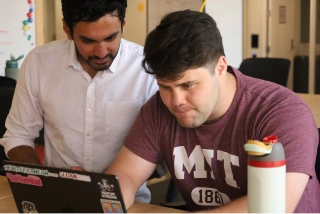

To be clear, we did not start only with site selection.
The broader mission of what we were building, and what we do, was to empower retailers using AI. We started working on everything – site selection, inventory optimization, customer engagement. If they had a problem, we wanted to help.
Over time, however, that same sentiment on site selection stuck in my brain. It became what we were best at. It took on more of our workstreams. And earlier this year, we decided we wanted to focus only on site selection.
So here we are now, still less than a year into building something that genuinely transforms how site selection is currently done.
How are we doing it?
Well first, we’re focused on the problem, not the solution. The problem is that our customers don’t know where to open a store. That makes sense – like we said before, site selection is hard and has a lot of variables that go into this critical business decision.
The problem, figuring out where to put a store, isn’t necessarily “solvable.” We won’t ever come out with something that says “here, put a store here, no questions asked.”
What we can do, however, is build solutions that are well designed and easy to use. We can give people time back in the day. We can help them identify clear losers or possible winners quickly. Instead of spending hours trying to get the demographic information, you should only be spending minutes. Instead of wondering “where can I find my customers that work in construction,” you can know the answer.
These tiny pockets of questions along the path of opening a store – that’s what we’re trying to solve. Specifically, we want to do it in a way that feels natural – just like air conditioning, you shouldn’t even notice when it’s working well. It just feels like home.
At the heart of all this, our mission goes beyond just helping retailers make better business decisions.
We’re focused on empowering small and mid-sized businesses to grow in ways they didn’t think possible—particularly in smaller towns and underserved markets.
When we help them open a store in the right place, we’re not just helping that one store succeed: we’re contributing to the revitalization of entire communities. There’s a ripple effect when businesses thrive in these areas, creating jobs, improving local economies, and ultimately, supporting the towns themselves. By making site selection smarter, easier, and faster, we’re helping our customers expand into places that are full of potential but often overlooked.
And this is just the beginning.
In the coming months, we’ll explore how we’re tackling site selection pain points in more detail, from cutting through the noise of demographic data to helping businesses find their ideal customers in any market.
Thanks for reading, and more to come.
Frequently Asked Questions
How is AI changing our genesis story?
Raj is one of the most curious and thoughtful minds I’ve ever met. He has worked in AI since he was 16, had years of experience as a technical AI consultant, and came to school hungry to build products.
How do I get started with our genesis story?
Begin by auditing your current workflow and identifying where manual processes slow you down. Modern platforms like GrowthFactor consolidate multiple data sources into a single interface, so you can move from research to decision in minutes rather than days. Most teams are fully productive within their first week.
What is GrowthFactor and what problem does it solve?
GrowthFactor is a retail site selection and location intelligence platform that helps growing retail chains and franchise brands find and evaluate new locations using data-driven analytics rather than gut instinct. The platform was built to address the disconnect between the complexity of modern site selection decisions and the limitations of spreadsheets and legacy tools that most real estate teams were relying on.
Why was GrowthFactor founded and what gap in the market did it address?
GrowthFactor was founded on the insight that enterprise-grade location intelligence capabilities were effectively out of reach for most growing retail brands — either locked behind expensive legacy platform contracts or requiring technical expertise that in-house real estate teams did not have. The founding premise was that making sophisticated site selection analytics accessible and actionable would fundamentally improve how mid-market retailers make expansion decisions.
How does GrowthFactor's approach differ from legacy site selection tools?
Where legacy platforms typically require lengthy implementation cycles and dedicated analysts to extract insights, GrowthFactor is designed so that real estate teams can surface actionable site scores, trade area profiles, and competitive analyses without specialized GIS training. The platform's interface is built around the decisions real estate teams actually make, not around the technical architecture of the underlying data.
What types of retailers use GrowthFactor?
GrowthFactor serves growing retail chains and franchise brands across a wide range of categories — from food and beverage and specialty retail to fitness, healthcare services, and experiential concepts — that are actively expanding their physical footprint and need a structured analytical process to guide site selection decisions. The platform is particularly well suited to organizations in the 10 to 300 location range that have outgrown spreadsheet-based site evaluation but do not yet have the scale to justify a dedicated in-house analytics function.
What data does GrowthFactor use to power its site selection recommendations?
GrowthFactor aggregates consumer demographic data, foot traffic patterns, competitive location data, trade area spending profiles, and lease market information into a unified analytical environment. By combining these data sources and calibrating them against a brand's own store performance data, the platform generates site scores that reflect each brand's specific customer profile rather than generic population metrics.
How does GrowthFactor help franchise brands manage multi-market expansion?
For franchise brands, GrowthFactor provides a systematic framework for evaluating candidate markets, scoring individual sites against the brand's proven location profile, and tracking the performance of the site selection process over time across a growing number of franchisees. This creates consistency in how site decisions are made across the franchise system — replacing a fragmented process where each franchisee evaluates sites differently and with different quality of information.
What makes GrowthFactor different from hiring a commercial real estate broker?
Commercial real estate brokers provide market access and transaction expertise, but their analytical capabilities are typically limited to locally available market data and experience-based intuition rather than nationally normalized location scoring. GrowthFactor complements broker relationships by giving brands an objective, data-driven scoring framework that evaluates every candidate site against consistent criteria — so the final site selection decision is informed by both broker market knowledge and platform-level analytics.
Is GrowthFactor designed for companies at a specific stage of growth?
GrowthFactor is designed for retail and franchise brands that are actively expanding — typically those opening three or more new locations per year — where the volume and complexity of site decisions creates enough analytical burden to make a structured platform valuable. Brands at an earlier stage can still benefit from the platform's market analysis and site scoring capabilities to validate their initial expansion markets before committing to a growth plan.
Citations
The human algorithm
Request Your demo
Schedule meeting
Or submit your information below and we'll be in touch to schedule.